From Offshore Exchange to Onchain Nasdaq
Why a $557M SpaceX token refund pushed Binance to assemble a licensed exchange, clearing house, and stablecoin broker-dealer in Abu Dhabi—and why sub-$2B cash-flow issuers are the real battleground.
Principia Research · 2026.11.18 · Deep Dive · BNB, USDC · ONCHAIN IPO, ADGM, BINANCE, RWA · 12 MIN
In June 2026, a somewhat awkward refund episode quietly exposed the central fault line in the migration of global capital-markets infrastructure.
At the time, Elon Musk’s SpaceX was preparing for its landmark Nasdaq debut. To capture crypto-native demand for the defining tech listing of the era, Binance Wallet partnered with third-party tokenization provider xStocks (backed by Backed) to launch an onchain IPO subscription campaign called SPCXx. Onchain telemetry recorded a striking response: within days, 27,689 unique wallet addresses committed $557 million in USDC.
The outcome, however, was a cold shower. Constrained by Wall Street’s closed primary underwriting syndicates, the upstream third-party provider could not secure sufficient physical SpaceX shares. Binance was forced to cancel the campaign, refund the $557 million in full, and distribute $1 million worth of its own Abu Dhabi-issued SPCXB tokens as goodwill compensation.
Most observers treated the episode as a minor operational hiccup. Yet when viewed alongside the capital, licensing, prospectus-filing, and hiring moves Binance has assembled inside the Abu Dhabi Global Market (ADGM) between 2025 and late 2026, a very different picture emerges:
The refunded $557 million proved that onchain capital is intensely hungry for primary equity formation; the third-party supply failure convinced Binance that rather than acting as a traffic funnel for small external RWA wrappers, it had to build a fully licensed "onchain securities exchange" in Abu Dhabi with its own underwriting, clearing, custody, and trading stack.
1. Why Abu Dhabi? Institutional Lineage and Sovereign Capital
Crypto has never lacked slogans about "putting stocks onchain." Back in 2021, both Binance and FTX launched early stock-token experiments, only to retreat under regulatory pressure from the U.S. and Europe. Five years later, why has Binance been able to assemble a full securities-market stack out in the open? The answer lies in ADGM’s personnel lineage and sovereign balance sheet.
The first anchor is leadership pedigree. Binance Co-CEO Richard Teng (who has shared the Co-CEO role with co-founder He Yi since late 2025) did not come up through unregulated offshore crypto. Before joining Binance, he served as Chief Regulatory Officer of the Singapore Exchange (SGX), and then spent six years (2015–2021) as the founding CEO of ADGM’s Financial Services Regulatory Authority (FSRA). Today’s widely cited ADGM regulatory framework for Digital Securities and Ledger-Based Securities bears the direct imprint of his tenure.
The second anchor is sovereign capital alignment. In March 2025, Abu Dhabi’s sovereign AI and advanced-technology investment vehicle MGX—chaired by Sheikh Tahnoon bin Zayed Al Nahyan—invested $2 billion in stablecoins for a minority stake in Binance. It was the first institutional equity investment in Binance’s history.
That $2 billion transaction reshaped Binance’s institutional footing: no longer an offshore exchange drifting across island jurisdictions, it became embedded in the UAE’s national fintech and capital-markets strategy. Just nine months later (approved in December 2025 and effective January 5, 2026), Binance formally exited the Cayman Islands and migrated its global Binance.com operating architecture into the ADGM regulatory perimeter.
2. Inside Abu Dhabi’s Regulated "Four-Piece" Stack
A close reading of the ADGM FSRA Public Register and prospectus filings reveals a crucial distinction: Binance did not settle for routine "crypto exchange licensing" (a standalone VASP permit). Instead, mirroring the functional separation of traditional Financial Market Infrastructures (FMIs) in London or New York, Irish group parent Binance Holdings (IE) Limited established a closed-loop matrix of three licensed institutions, a prospectus-issuing SPV, and an onchain servicing agent:
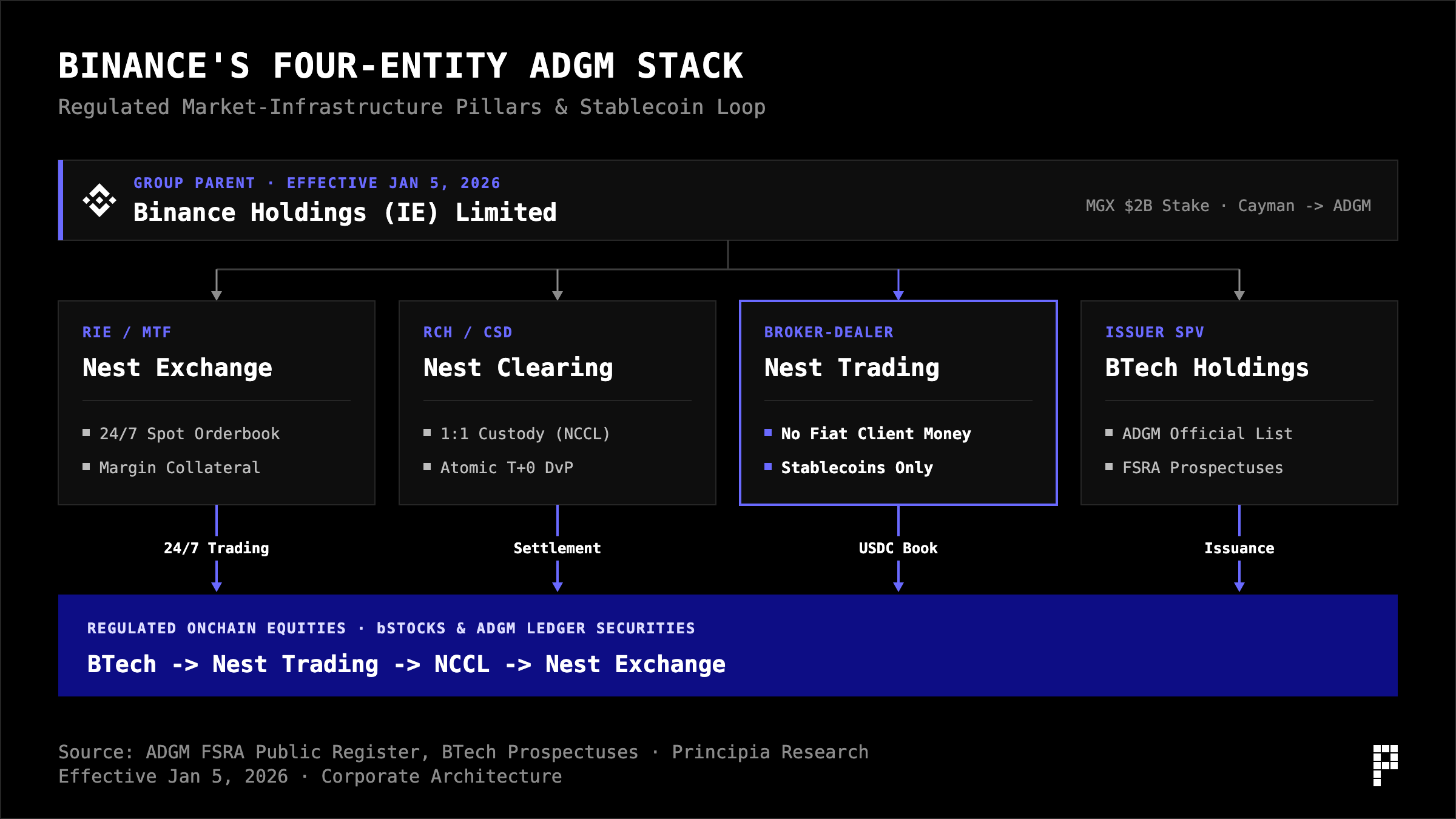
A side-by-side comparison with Wall Street makes each entity’s role unmistakable:
- Nest Exchange Limited (formerly Nest Services) holds Recognised Investment Exchange (RIE) and Multilateral Trading Facility (MTF) permissions—playing the role of Nasdaq or the NYSE;
- Nest Clearing and Custody Limited (NCCL) (formerly Binance AD) holds Recognised Clearing House (RCH) and Central Securities Depository (CSD) permissions—playing the role of DTCC;
- Nest Trading Limited (formerly BCI Limited) holds Broker-Dealer permissions covering Dealing in Investments as Principal (the statutory basis for firm underwriting and market-making), Dealing in Investments as Agent (agency placement), and Arranging Deals in Investments (roadshow book-building)—playing the role of investment-bank underwriting and distribution;
- BTech Holdings Limited (supported by minting and reporting agent BTech Services Limited) serves as the dedicated issuing SPV filing prospectuses with the FSRA for admission to the ADGM Official List.
The tell sits in Nest Trading Limited’s license conditions on the FSRA Public Register: it is explicitly prohibited from holding or controlling traditional fiat Client Money, and its money-services permission is restricted strictly to Accepted Fiat-Referenced Tokens (regulated stablecoins such as USDC). To a conventional brokerage, a ban on fiat client money would look crippling. Through an onchain capital-markets lens, it is purpose-built for On-chain IPOs—eliminating slow correspondent bank wires and fiat trust accounts at the statutory level, and locking in a pure onchain loop of regulated stablecoin subscriptions plus atomic T+0 Delivery-versus-Payment (DvP) settlement at NCCL.
Binance’s UAE hiring activity reinforces this conclusion. Its careers portal recently opened "0-to-1 Equity Capital Markets (ECM)" Business Development and Research Analyst roles tasked explicitly with "identifying and engaging prospective issuers and investment banks, conducting issuer due diligence, building transaction pricing models, and submitting internal investment-committee memos." An exchange content with mapping secondary U.S. equities does not build an ECM origination desk to pitch corporate issuers.
3. From Secondary Equity Mapper to Weekly Regulatory Conveyor Belt
Before pitching corporate issuers on primary listings, Binance used the second half of 2026 to run a textbook regulatory and infrastructure stress test in ADGM via its tokenized securities product, bStocks.
On June 11, 2026—advised by international law firm Gibson Dunn and Middle East firm Al Tamimi & Co.—BTech Holdings’ inaugural bStocks were admitted to the ADGM Official List and began trading on Nest Exchange. It marked the first time in Abu Dhabi’s history that public-blockchain tokenized securities (running as BEP-20 / BEP-677 tokens on BNB Smart Chain) were admitted to an official statutory securities list.
That immediately raised the central market question: when underlying U.S. shares like Tesla or NVIDIA remain immobilized inside DTCC, on what basis does ADGM treat bStocks as "1:1 backed"?
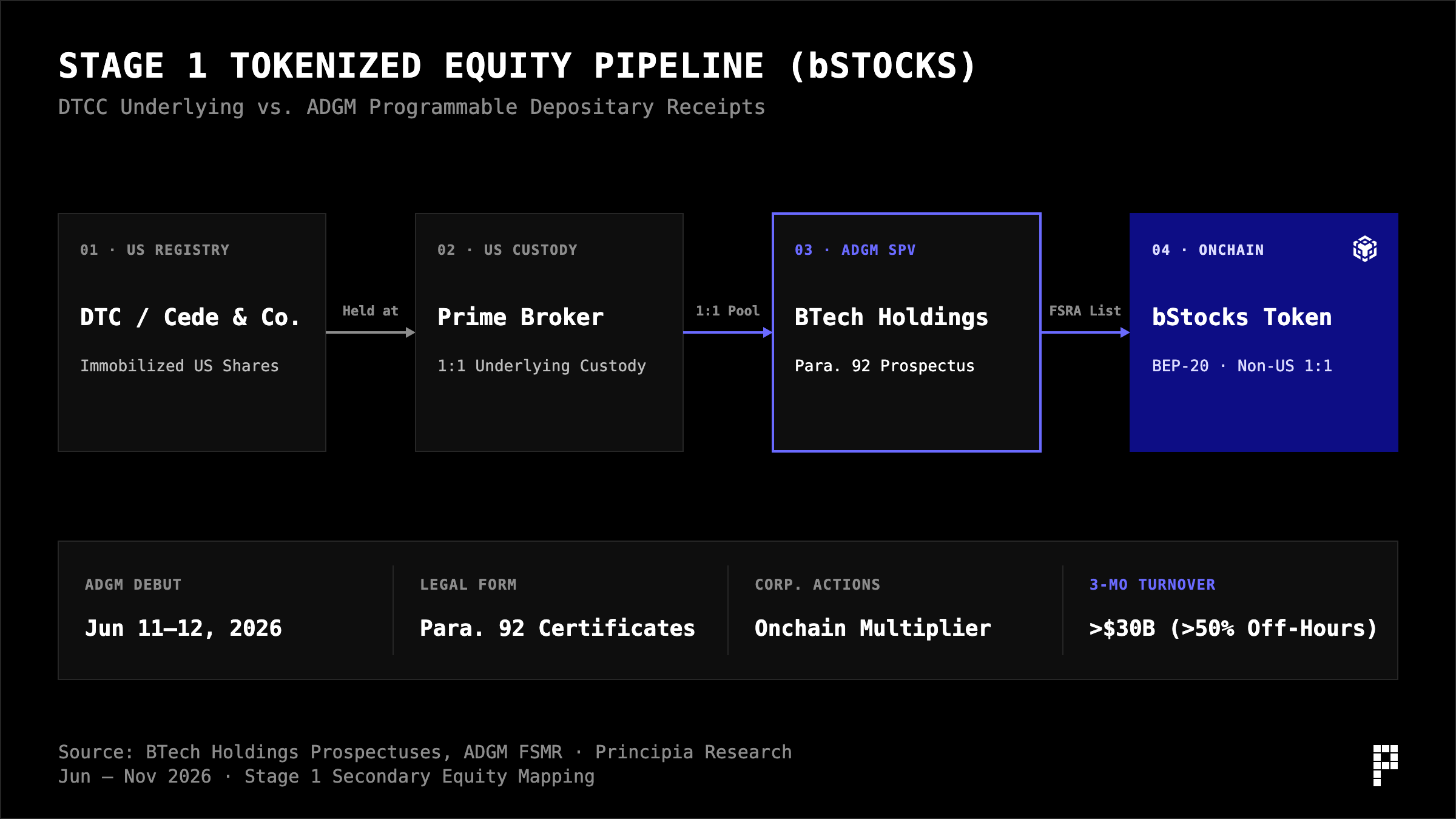
The answer lies in legal precision and transparency: in Stage 1 (mapping existing secondary equities), the underlying shares never leave the DTCC system. Under Paragraph 92 of Schedule 1 to the ADGM Financial Services and Markets Regulations (FSMR), bStocks are legally classified as "Certificates representing certain Financial Instruments"—in effect, programmable onchain depositary receipts. The FSRA does not audit each share in real time; instead, through prospectus approval, it binds BTech Holdings to 1:1 bankruptcy-remote segregated custody, periodic reconciliation, and Proof of Reserves backed by strict civil and criminal disclosure liability. Technically, BTech Services embeds a smart-contract Multiplier that automates stock splits and net cash dividend reinvestments natively onchain without token swaps.
Equally striking is the acceleration in regulatory turnaround over the following five months. Traditional prospectus reviews take months—far too slow for a two-week IPO roadshow window. Yet between June and November 2026, BTech Holdings turned ADGM Official List admissions into a weekly conveyor belt:
- Early July: Immediately after Italian tech group Bending Spoons debuted on Nasdaq on July 1 (ticker BSP, priced at $29), BTech cleared a standalone prospectus to launch BSPB and enabled Cross and Portfolio Margin collateral on Binance—proving fast-follow IPO onboarding and margin-collateral utility;
- Late July to August: Cleared 3x leveraged Nasdaq ETF (TQQQ) and high-volatility retail favorite GameStop (GME), establishing disclosure templates for leveraged structures and high-volatility equities;
- September: Listed Hims & Hers and Salesforce on September 9, CEA Industries on September 14, and Forward Industries on September 29—compressing approval intervals to 5–15 days and proving that non-blue-chip small- and mid-cap digital-asset treasury (DAT) equities could clear review rapidly;
- October to early November: Cleared a multi-asset batch of BlackBerry, MongoDB, Penguin Solutions, and Ultra VIX (UVXY) on October 13–14, followed just six days later by Berkshire Hathaway (BRKB) on October 20, and a 2x Long Intel ETF (INTW) supplementary prospectus on November 6.
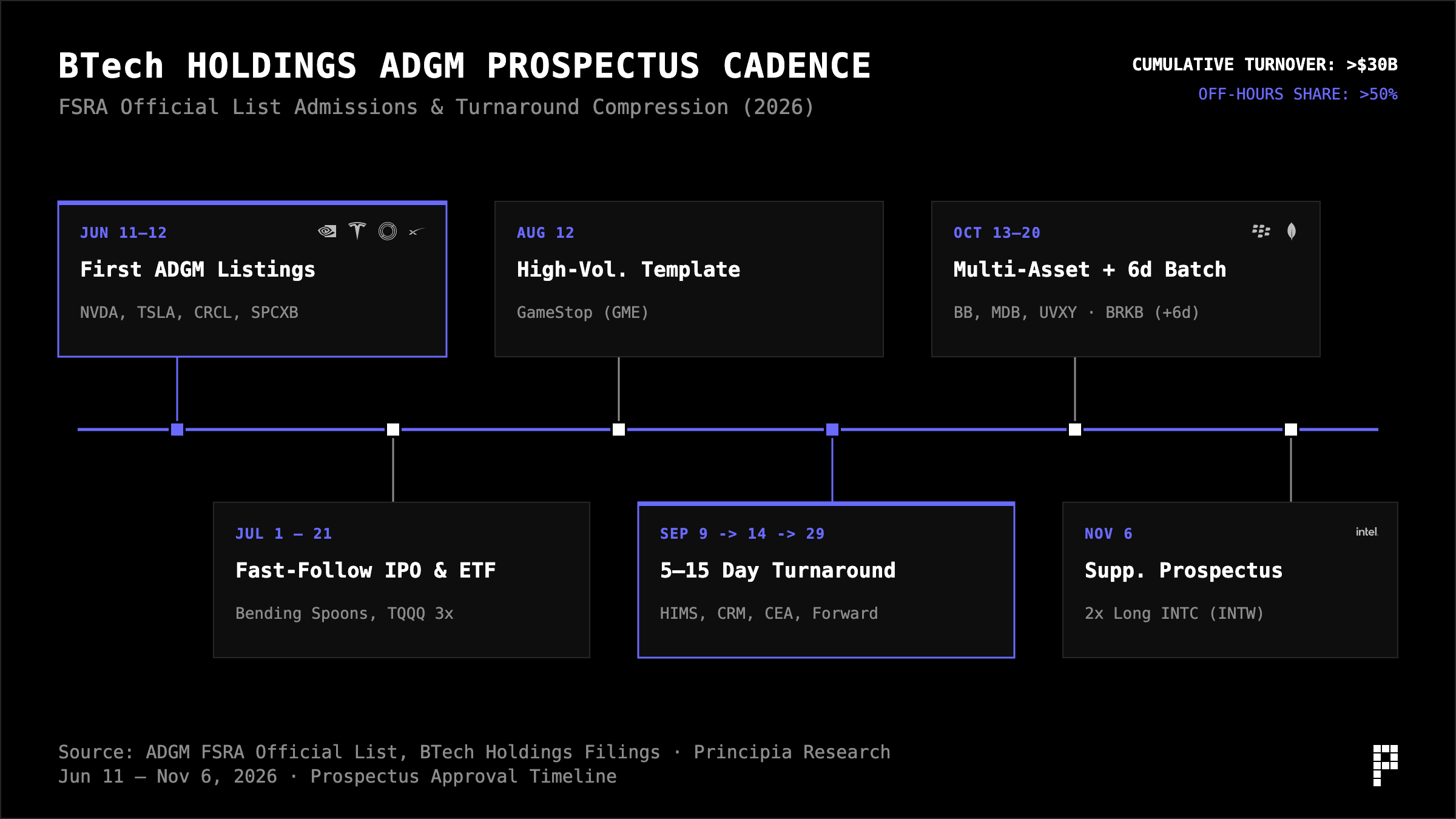
Within three months (by early September 2026), cumulative bStocks turnover surpassed $30 billion, with over 50% of volume executing outside regular U.S. market hours (during Asian daylight, Middle East hours, and weekends). With the rails, liquidity, market makers, and regulatory cadence validated, the only remaining step is crossing from secondary equity wrappers to native primary On-chain IPOs.
4. The Traditional IPO Trap and Global Exchange Liquidity Reordering
Why are global retail investors and corporate issuers converging on a "third rail"? Empirical data from the Principia Intelligence Suite highlights both the structural imbalance of traditional primary markets and the liquidity gravity of leading crypto venues.
1. Structural Extraction in Traditional IPOs: $329.1B Left on the Table and Low-Float Decay
Across 650 traditional IPOs (≥ $50M proceeds, ex-SPAC, totaling $441.33 billion in gross proceeds) tracked by Principia, two stark patterns stand out:
- Institutional Pop vs. Public Drawdown: The average jump from Offer Price to First Open is +29.6%, representing $329.14 billion in "Money Left on the Table" at the Day-1 close—virtually risk-free primary upside captured almost exclusively by Wall Street’s institutional syndicate clients. By contrast, once public investors buy at the opening print, 64.1% of companies trade below their offer price, with a median return of -36.0% from first open to date.
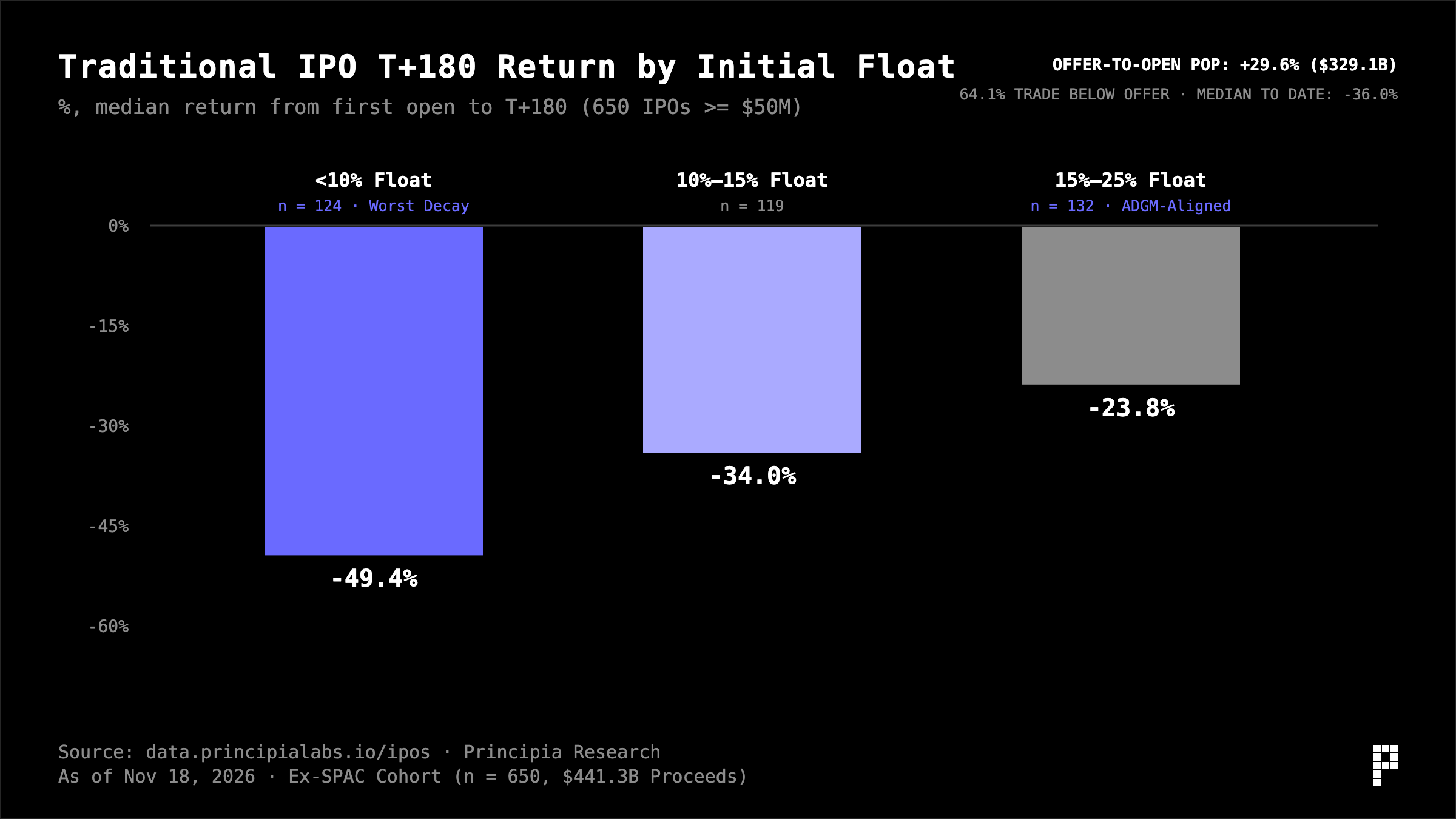
- The Low-Float Bleed Curve: Grouping those same 650 IPOs by initial free float exposes a remarkably consistent decay pattern:
- <10% Float (124 deals): Median drawdown reaches -49.4% by T+180 (-44.4% to date);
- 10%–15% Float (119 deals): Median T+180 drawdown improves to -34.0%;
- 15%–25% Float (132 deals): Median T+180 drawdown tightens to -23.8%—cutting losses in half versus sub-10% launches;
- Around the 180-day Lock-up Cliff (n = 319), low-float deals (<15%) suffer the sharpest window drawdown at -10.5%.
This empirical evidence explains both why $557 million rushed into SPCXx for primary offer-price access (the only way to avoid the -36.0% secondary drawdown trap) and why ADGM’s statutory 15%–20% minimum public float (MKT Rule 2.3.10, "Shares in Public Hands") is structurally sound.
2. Where Binance’s Liquidity Actually Ranks
Traditional finance executives often assume crypto exchanges trade at a fraction of major stock-exchange volume. The actual numbers tell a very different story:
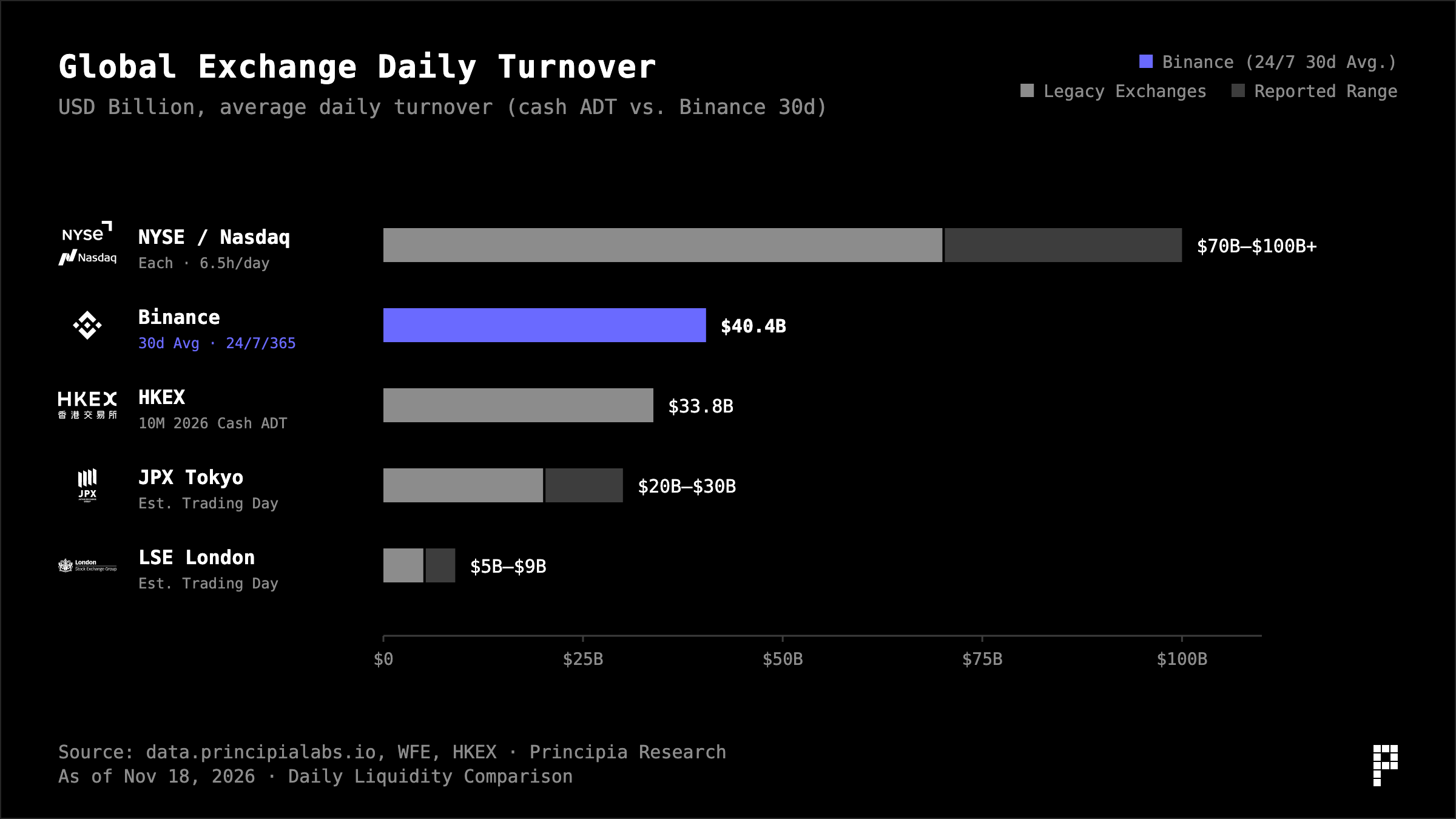
In full-year 2025, Binance’s spot volume exceeded $7.1 trillion—matching the tier of HKEX ($7.88 trillion)—while its combined 30-day rolling liquidity ($40.4 billion/calendar day) now surpasses HKEX’s cash average daily turnover ($33.8 billion in 10M 2026).
Even more telling is the tokenized equities, ETFs, and commodities vertical tracked on Principia (as of November 18, 2026: $8.59 billion tokenized market cap across 804 active assets and 187 global venues):
- Sector-wide 24h volume reached $1.79 billion in spot and $50.52 billion in derivatives (28.3x spot), with $11.22 billion in open interest;
- Binance alone commands 41% of global RWA volume ($470.6 million 24h spot + $20.90 billion 24h derivatives + $3.47 billion open interest, backed by $112.71 billion in tracked exchange reserves)—4.3x the share of second-place OKX (9.5%).
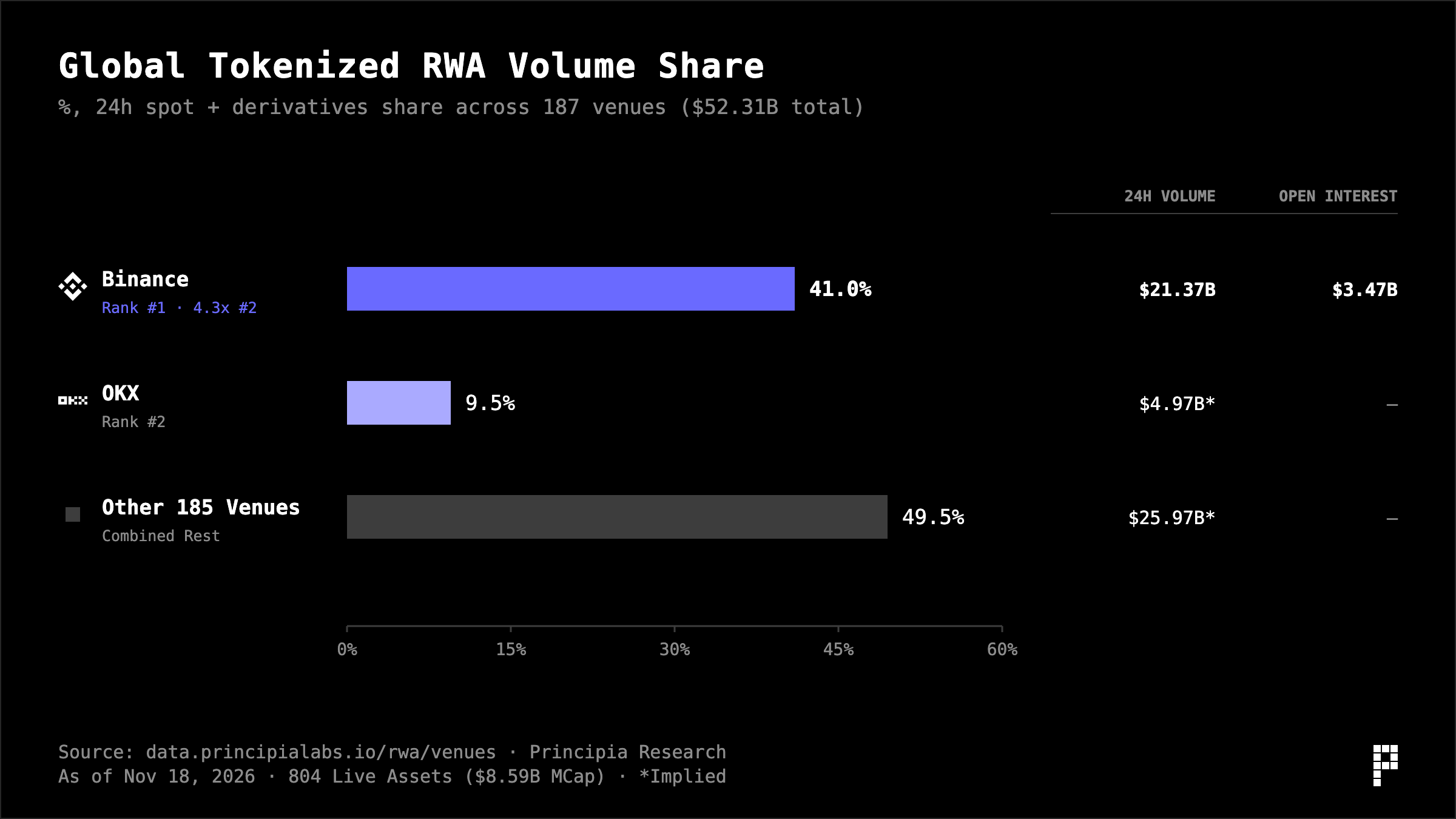
When a 24/7/365 venue averaging $40.4 billion/day over 30 days and controlling 41% of global tokenized-asset flow activates a licensed ADGM exchange (RIE) and broker-dealer stack, the competitive pressure on regional stock exchanges is only beginning.
5. The Forgotten Middle: Sub-$2B Cash-Flow Issuers
In the second half of 2026, CZ declared that "IPOs will move on-chain," while Binance Research published reports such as From IPO to Internet Capital Markets, framing a three-way race in onchain equity issuance:
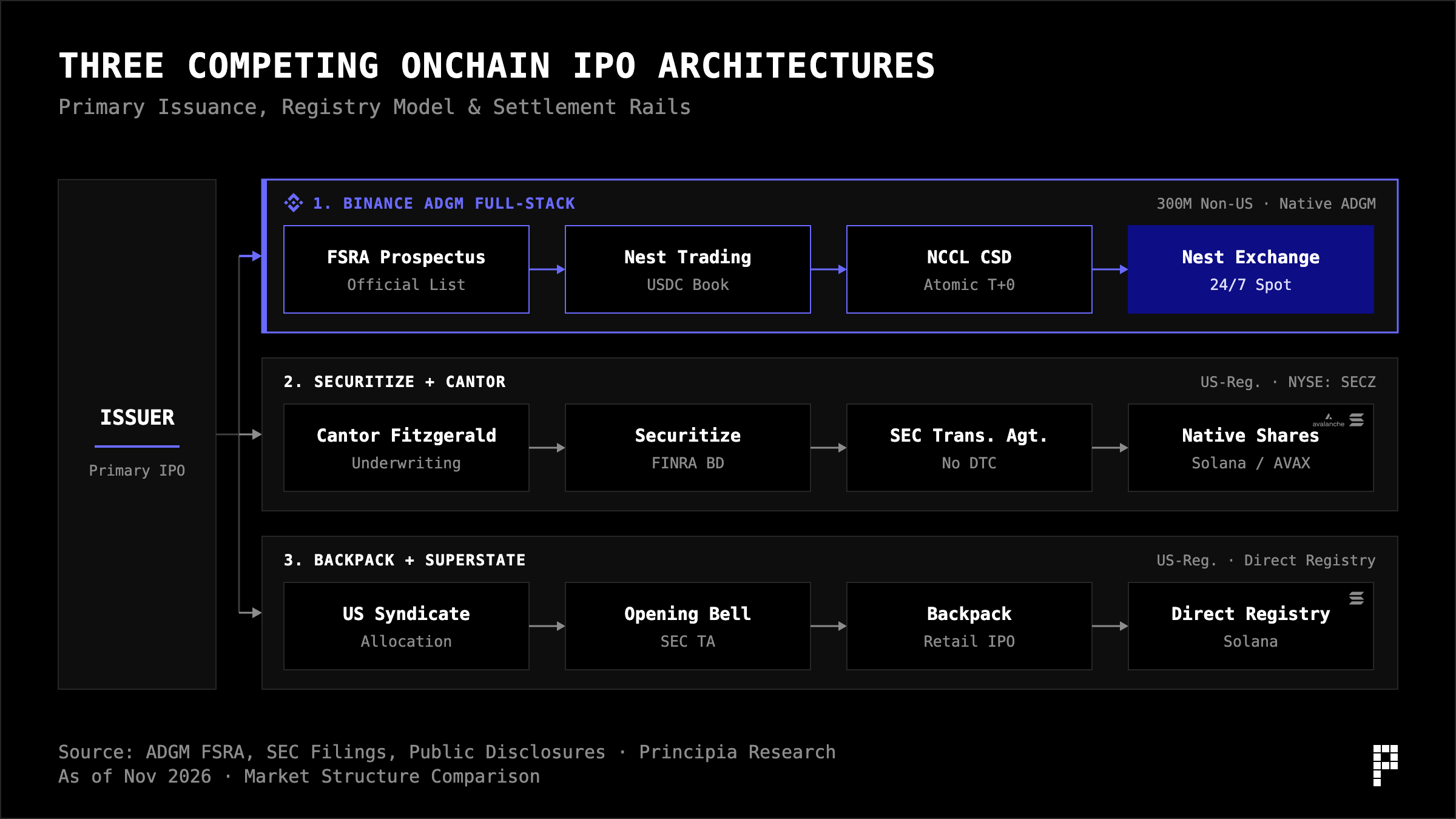
Comparing these three models exposes a common misconception: assuming Binance intends to fight Wall Street for flagship mandates like SpaceX or Anthropic (ANT, currently in a $74 billion book-build).
In reality, the breakout battleground for Binance’s ADGM onchain IPO venue is not mega-cap giants—it is profitable, cash-generative growth companies valued between $100 million and $2 billion, the "mid-cap orphan zone."
The market-structure math makes this clear:
1. Structural Orphans on Legacy Venues vs. ADGM’s Statutory Advantage
On Nasdaq or HKEX today, a profitable growth company generating $3 million to $30 million in net income at a $100 million–$800 million valuation—whether an outbound AI application, cross-border fintech, gaming publisher, or cash-generative crypto infrastructure firm—faces severe friction:
- Too expensive and ignored in the U.S.: Bulge-bracket banks such as Goldman Sachs and Morgan Stanley rarely prioritize sub-$1 billion IPOs; smaller underwriters charge $2 million–$3 million in upfront legal, audit, and compliance fees plus a 7% underwriting spread, followed by zero Wall Street research coverage and ~$1.5 million in annual public-company overhead;
- Illiquid "zombie" listings on regional venues: Although HKEX clears $23.2 billion–$33.8 billion per day in headline turnover, liquidity concentrates overwhelmingly in mega-cap index weights like Tencent and Alibaba—leaving mid-cap tech stocks stuck at single-digit P/E multiples and sub-$100,000 daily turnover, unable to raise follow-on capital or offer shareholder exits.
By contrast, a native primary listing on ADGM fundamentally resets both thresholds and costs:
- Accessible statutory eligibility: Under ADGM MKT Rule 2.3.15 (Profits Test), an issuer qualifies with $1 million in aggregated profit over three full financial years and $500,000 in consolidated profit over the trailing twelve months (pre-profit tech firms can use MKT 2.3.16: $10 million market cap or $3 million net tangible assets plus $1.5 million in pro forma working capital);
- Near-zero regulatory fees: Direct FSRA fees total just $23,000 ($20,000 prospectus filing + $3,000 Official List admission); even factoring in international counsel, audit, and advisory costs, total pre-listing expenses are roughly one-quarter to one-third of a U.S. IPO.
2. Statutory Float Tiers Meet Crypto Liquidity
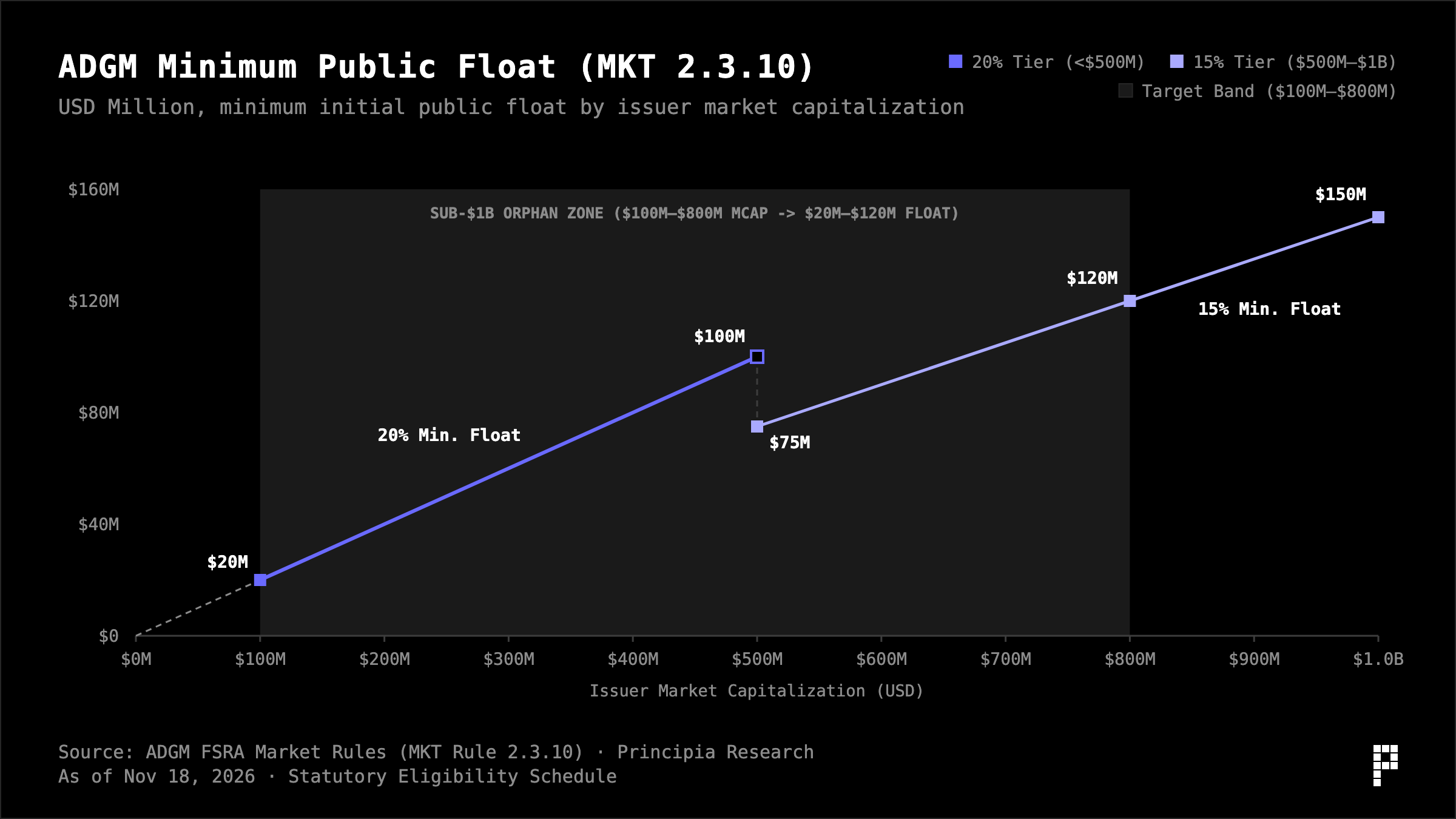
Equally compelling is the sizing alignment. Under ADGM MKT Rule 2.3.10:
- Issuers under $500 million market cap require a minimum 20% Public Float;
- Issuers between $500 million and $1 billion market cap require a minimum 15% Public Float.
For a $100 million–$800 million company listing natively in ADGM, that translates into an initial public float of $20 million to $120 million in USDC. In legacy equity markets, that is an overlooked micro-cap; inside Binance’s ecosystem of 300 million registered users and $40.4 billion in 30-day daily turnover, a $20 million–$120 million initial float is the exact sweet spot—small enough to clear multi-times oversubscribed, large enough to sustain deep 24/7 spot velocity without draining orderbooks.
From "Circulating Supply" to "Shares in Public Hands": For Web3 teams accustomed to Token Generation Events (TGEs), On-chain IPOs enforce a structural reset. In past token launches, projects routinely padded "initial circulating supply" with market-maker token loans, unlocked ecosystem reserves, and foundation wallets. Under ADGM MKT Rule 2.3.10(3), shares held by directors, connected persons, employee share scheme (ESOP) trustees, 5%+ blockholders, or non-firm market-maker loans are strictly excluded from "shares in public hands." Only genuine holdings by independent public investors count—ending the "high-FDV, low-float" playbook.
6. Will the House Eventually List Its Own Equity?
Behind Binance’s Abu Dhabi buildout sits an even bigger industry question: beyond operating the venue for other companies’ On-chain IPOs, could Binance—or its Abu Dhabi arm—eventually list its own equity natively in ADGM?
At the parent level, Co-CEO Richard Teng has repeatedly stated between 2025 and 2026 that Binance’s cash generation removes any near-term need for a fundraising IPO. Prospectus disclosures for BTech Holdings confirm that Irish parent Binance Holdings (IE) Limited remains majority-owned by founder Changpeng Zhao (CZ) as ultimate beneficial owner (UBO), meaning a full group-level public listing faces high hurdles around consolidated global financial disclosures and legacy compliance.
Yet "no group-level IPO" does not preclude "ring-fenced subsidiary listings."
Two shifts are already underway: first, $2 billion sovereign shareholder MGX naturally carries medium-to-long-term valuation benchmarking and exit-optionality imperatives; second, in July 2026, U.S. tokenization leader Securitize listed on the NYSE (NYSE: SECZ) while simultaneously issuing native shares on Solana and Avalanche—proving the viability of dual exchange-and-onchain public equity.
Meanwhile, Binance’s four ADGM entities (the Nest trading/clearing stack and bStocks vertical) have operated independently under strict FSRA audit since January 2026, ring-fenced from legacy offshore structures and generating massive recurring cash flows. Should Binance ever choose to package a regulated Abu Dhabi financial subsidiary or joint venture for a dual native listing on the Abu Dhabi Securities Exchange (ADX) and Nest Exchange, the legal and settlement rails are already live.
New Rails Demand a New Advisory Ecosystem
Over the past decade, crypto capital formation has swung from unregulated 2017 ICOs to distorted 2021–2024 "high-FDV VC tokens," finally converging in 2026 on real corporate cash flows, statutory securities prospectuses, and 24/7 stablecoin settlement.
By assembling a licensed exchange, central securities depository, stablecoin broker-dealer, and modular prospectus pipeline in ADGM, Binance has effectively opened a third public capital-formation rail alongside Wall Street and Hong Kong—Internet Capital Markets.
Along this emerging value chain, the opportunity extends well beyond the exchange itself. When the opening bell first rings on an always-on blockchain ledger, every convention of pricing, underwriting, and liquidity management will be rewritten.