PaperTrade: Leveraged Tokenomics and Its Break-Even
An on-chain perpetuals exchange on Hyperliquid where users trade against the LP, losing traders receive PAPER, and staked PAPER earns a share of LP revenue.
Principia Research · 2026.10.12 · Deep Dive · PAPER · PERPS, TOKENOMICS, HYPERLIQUID · 6 MIN
Origins
PaperTrade is an on-chain perpetuals exchange built on Hyperliquid. Users aren't matched against other traders — they trade directly against the LP, with up to 1000× leverage. No order book, no slippage, no funding rates. The LP starts from zero and grows on user losses; losing traders receive PAPER tokens, and staked PAPER earns a share of LP revenue.
The idea behind PaperTrade comes from Rollbit, a well-known crypto gambling platform. Users bet directly against the platform instead of trading in a real market, and the platform takes a cut of winners' profits. PaperTrade's fee formula is adapted from this model. Rollbit's platform token, RLB, had its moment in the spotlight thanks to revenue-funded buyback-and-burn.
Mechanism Design
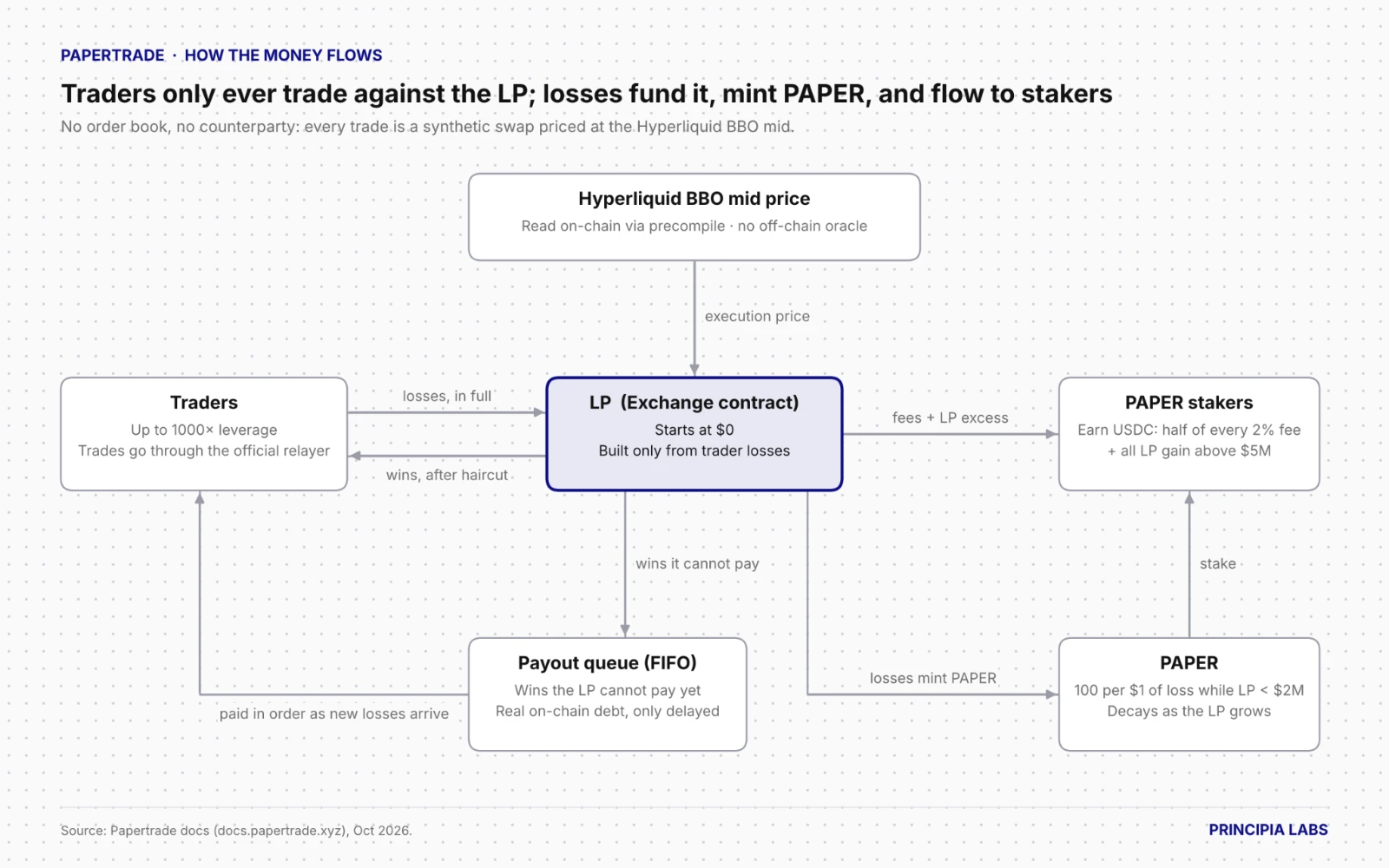
Step 1: Deposit. Alex sends $1,000 USDC from Hyperliquid to his dedicated deposit address; within seconds it shows up in his trading balance.
Step 2: Open a position. He opens a BTC long with $100 margin at 100× leverage — $10,000 notional. The contract reads Hyperliquid's best bid/ask midpoint, say $83,600, and fills at that price. There's no counterparty: the other side of the trade is the LP.
Step 3: Close — three possible outcomes.
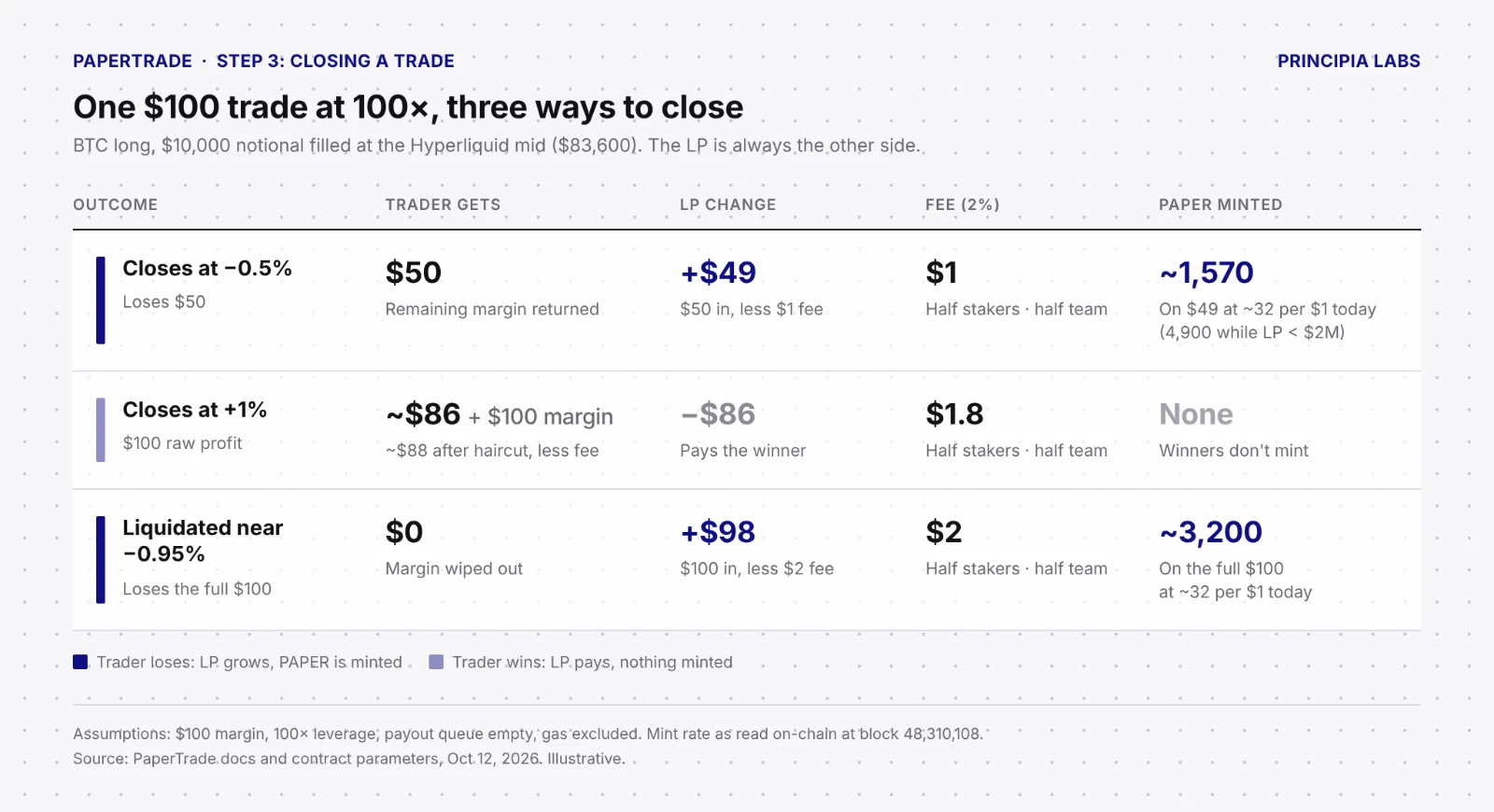
Step 4: What if the LP can't pay? If the LP doesn't hold enough to cover Alex's profit, his margin is still returned immediately and the unpaid profit goes into a payout queue. When other traders lose, that money pays down the queue first, and Alex gets paid in turn.
Step 5: PAPER becomes income. Alex stakes the PAPER he received from his losses. From then on, half of the 2% fee on every trade is distributed to him in USDC, pro rata to his stake. Once the LP exceeds $5M, everything above that is also distributed to stakers.
On-Chain Data
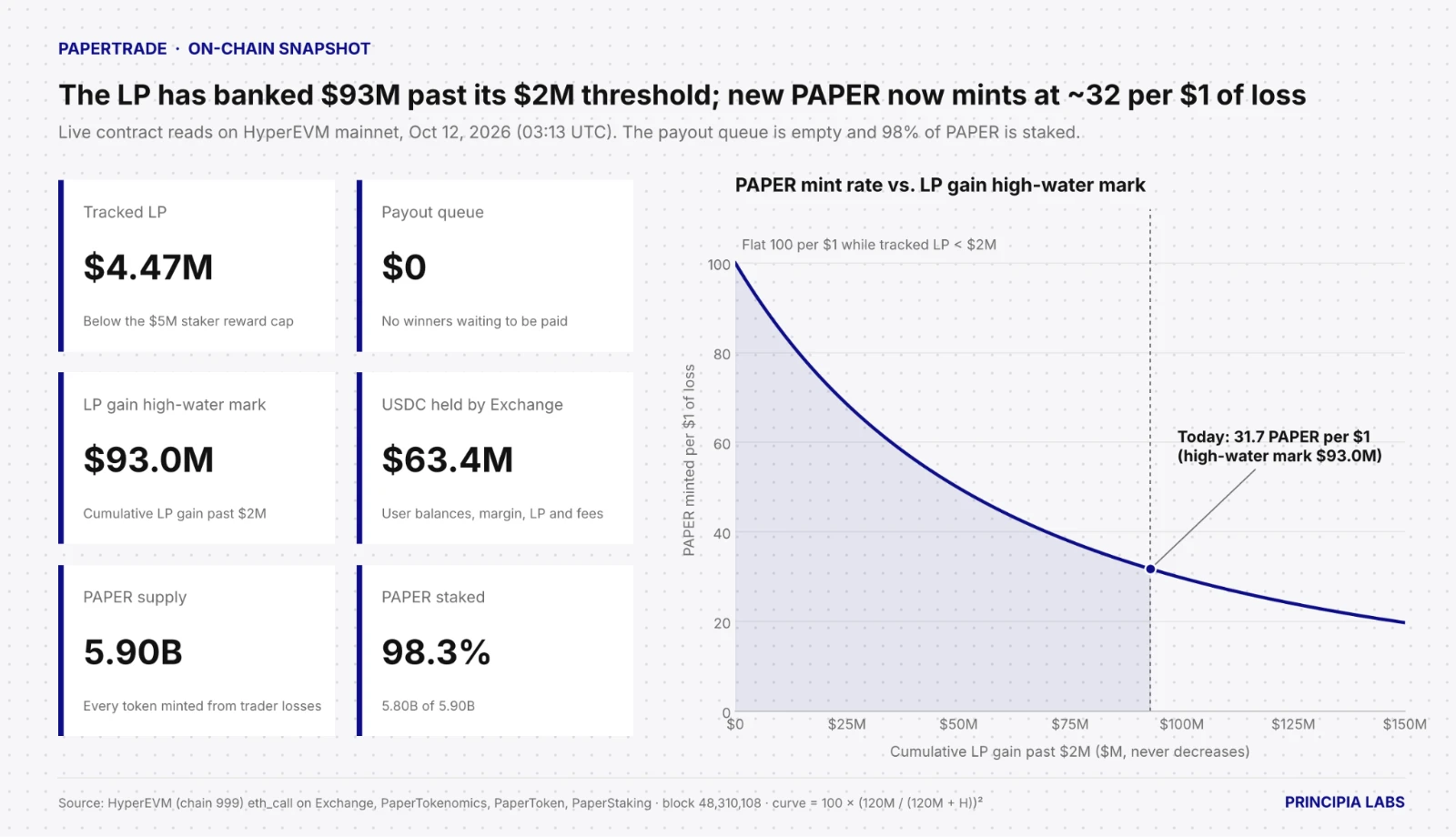
Reading the HyperEVM contracts directly (block 48,310,108): cumulative earnings above the $2M LP mark have peaked at $93.0M, and each $1 of losses now mints only ~32 PAPER. Precedents such as GMX's GLP and Hyperliquid's HLP show that retail traders have negative expected value against the pool, so over longer time horizons the LP should stay profitable. Because PAPER can't be traded yet, 98% of it is staked.
By our count, about 46% of open exposure is self-hedged — the same wallet holding both a long and a short in the same market. Across the whole market, 96% of BTC longs and shorts offset each other, and 81% for ETH.
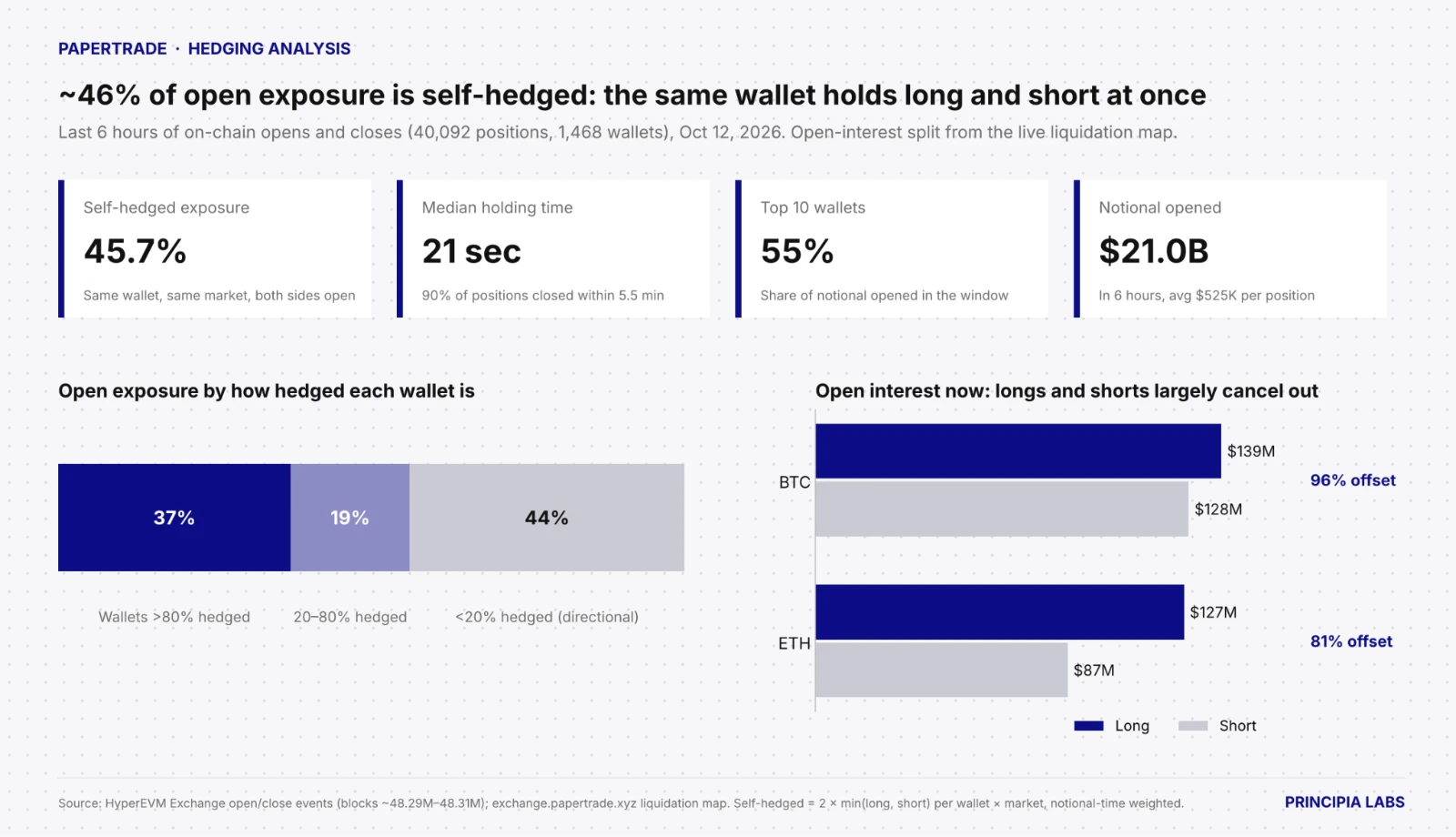
On-chain data shows extremely short holding times: the median is 21 seconds, and 90% of positions are closed within 5.5 minutes. The top 10 wallets account for 55% of opened notional.
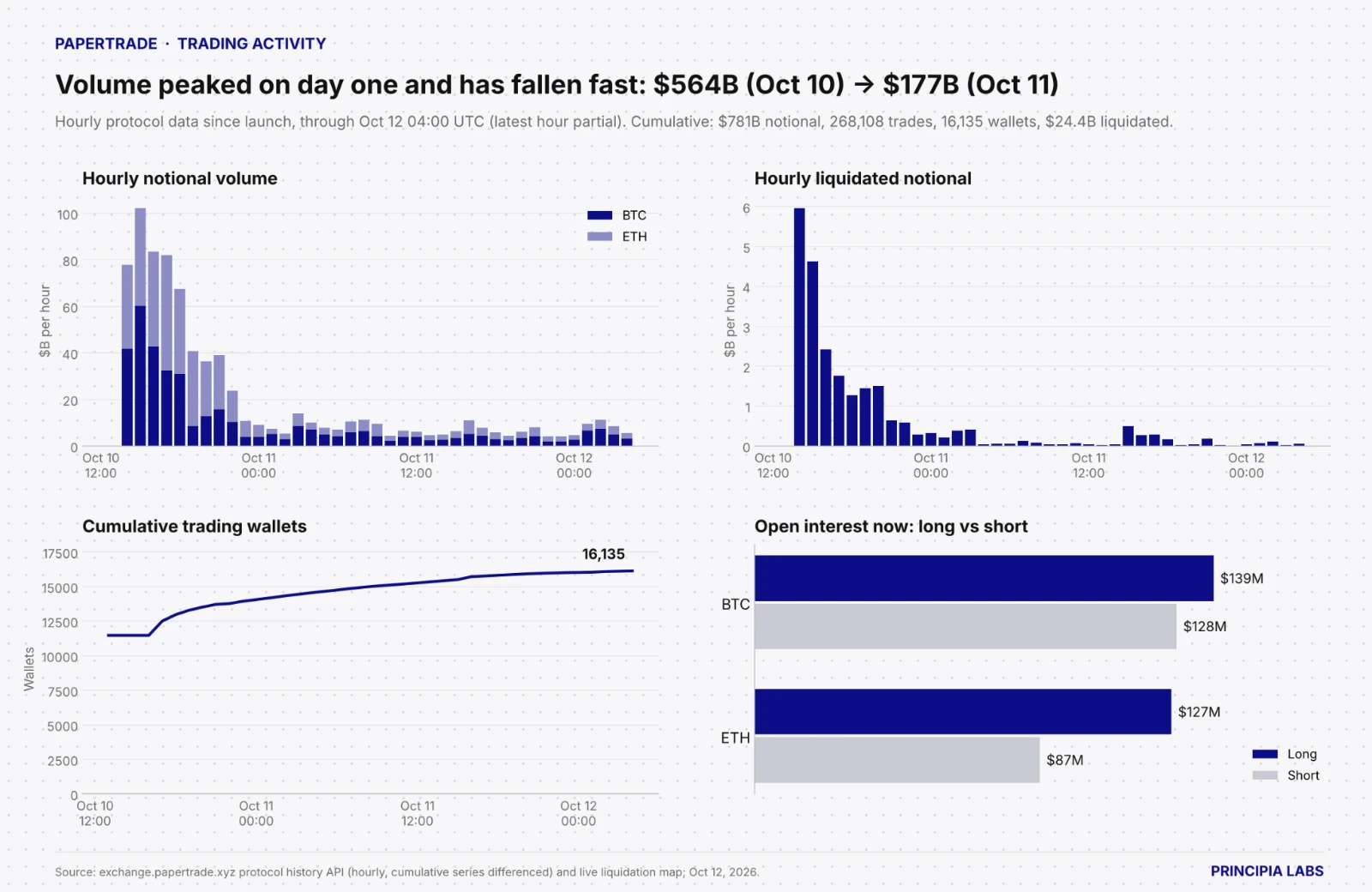
Volume peaked on day one and fell off fast: ~$564B on 10/10 and ~$177B on 10/11. Cumulative notional volume stands at $781B across 268K trades and 16,135 wallets, with $24.4B in liquidated notional; traders are down ~$32.6M net in total. About 11.5K wallets were already in before launch (the pre-deposit phase), and wallet growth slowed noticeably afterward.
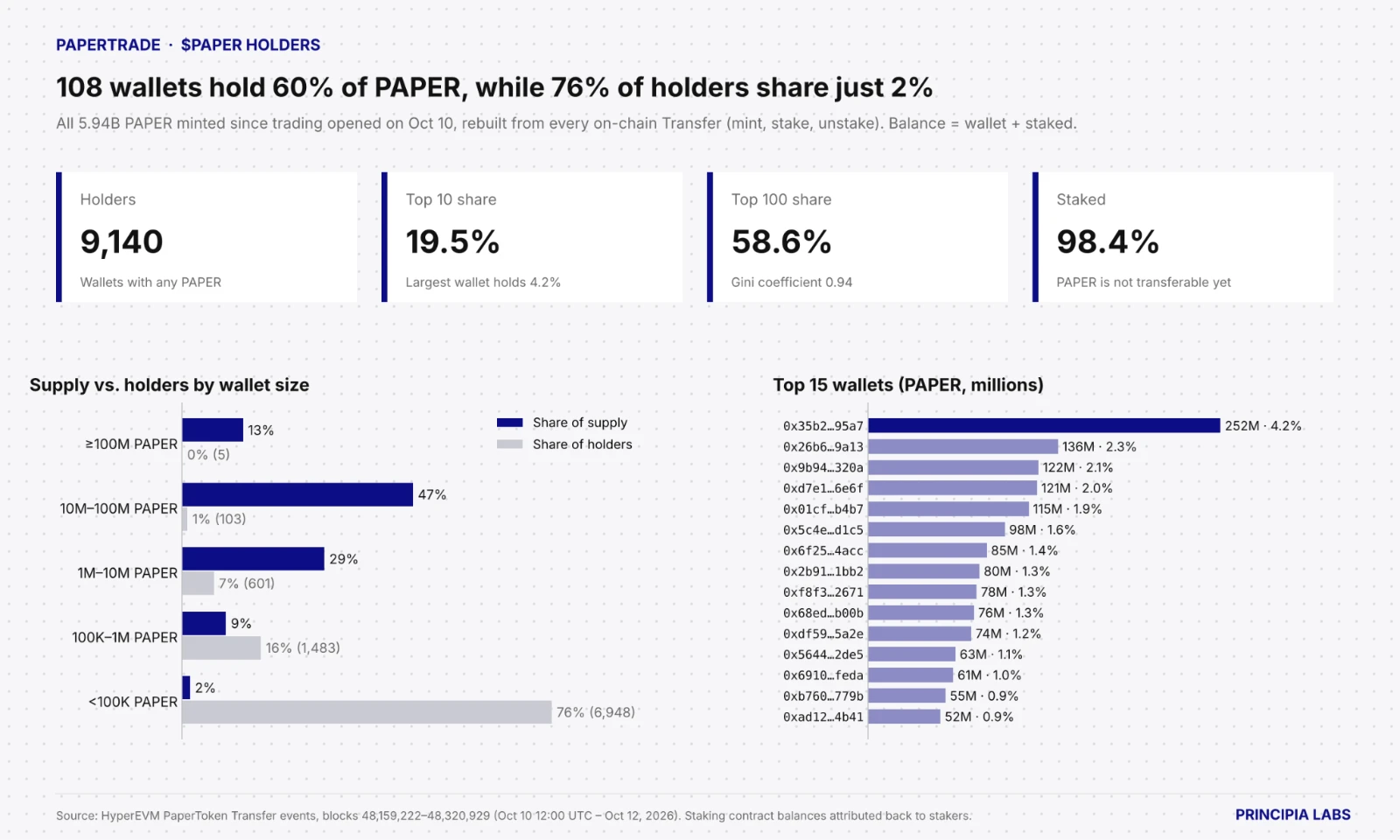
As of 2026-10-12 03:13 UTC, a total of 5.94B PAPER has been minted, held across 9,140 addresses, with about 98.4% staked. Large holders are mostly day-one participants: 108 wallets hold more than 10M PAPER, and only 23 of them have traded in the past 6 hours, contributing 8.7% of opened volume. In other words, whales aren't adding to their positions and raising their cost basis.
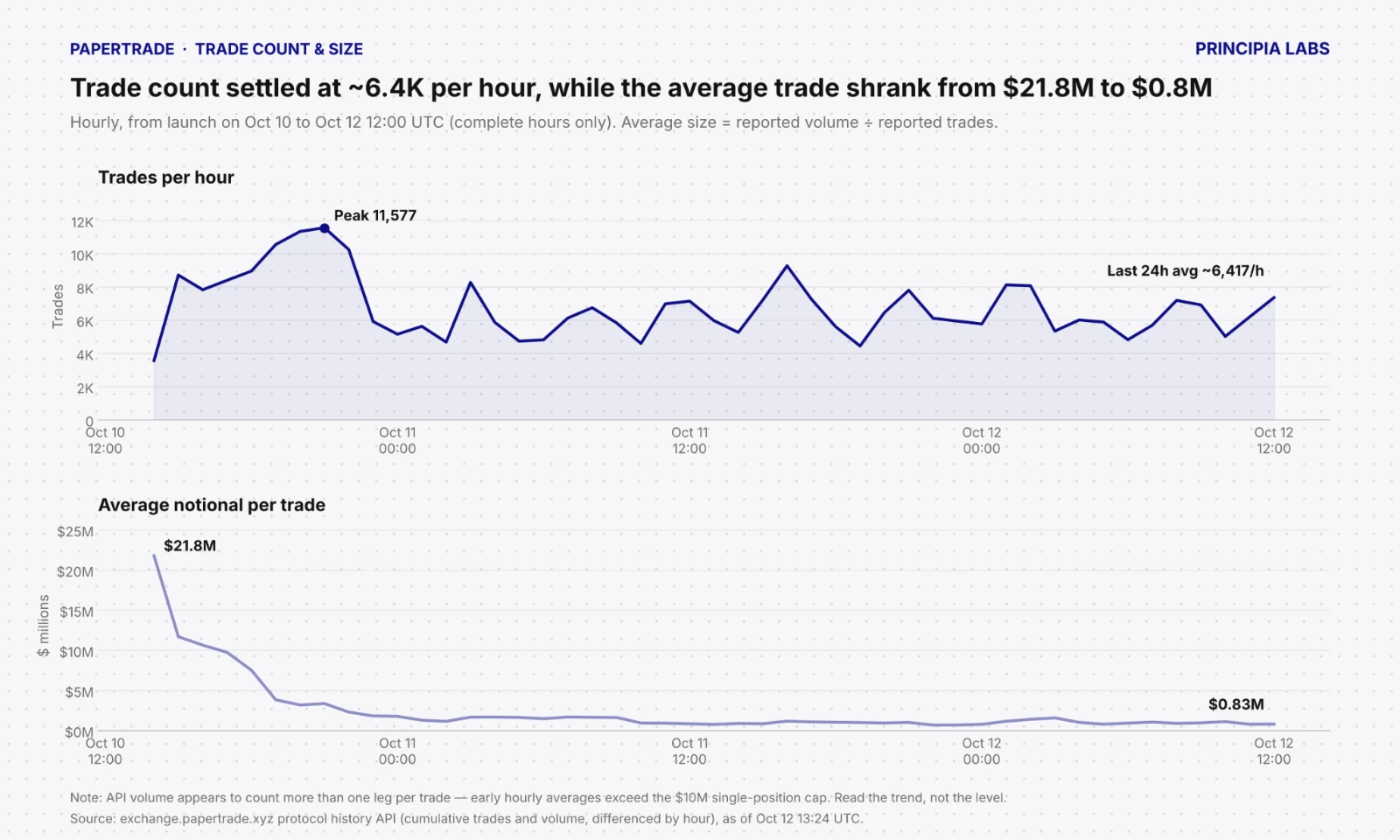
Trade count quickly settled at about 6,400 per hour after launch, while average notional per trade fell from ~$21.8M to ~$0.8M. The big whale orders are fading; what's left is small, high-frequency flow.
Tokenomics
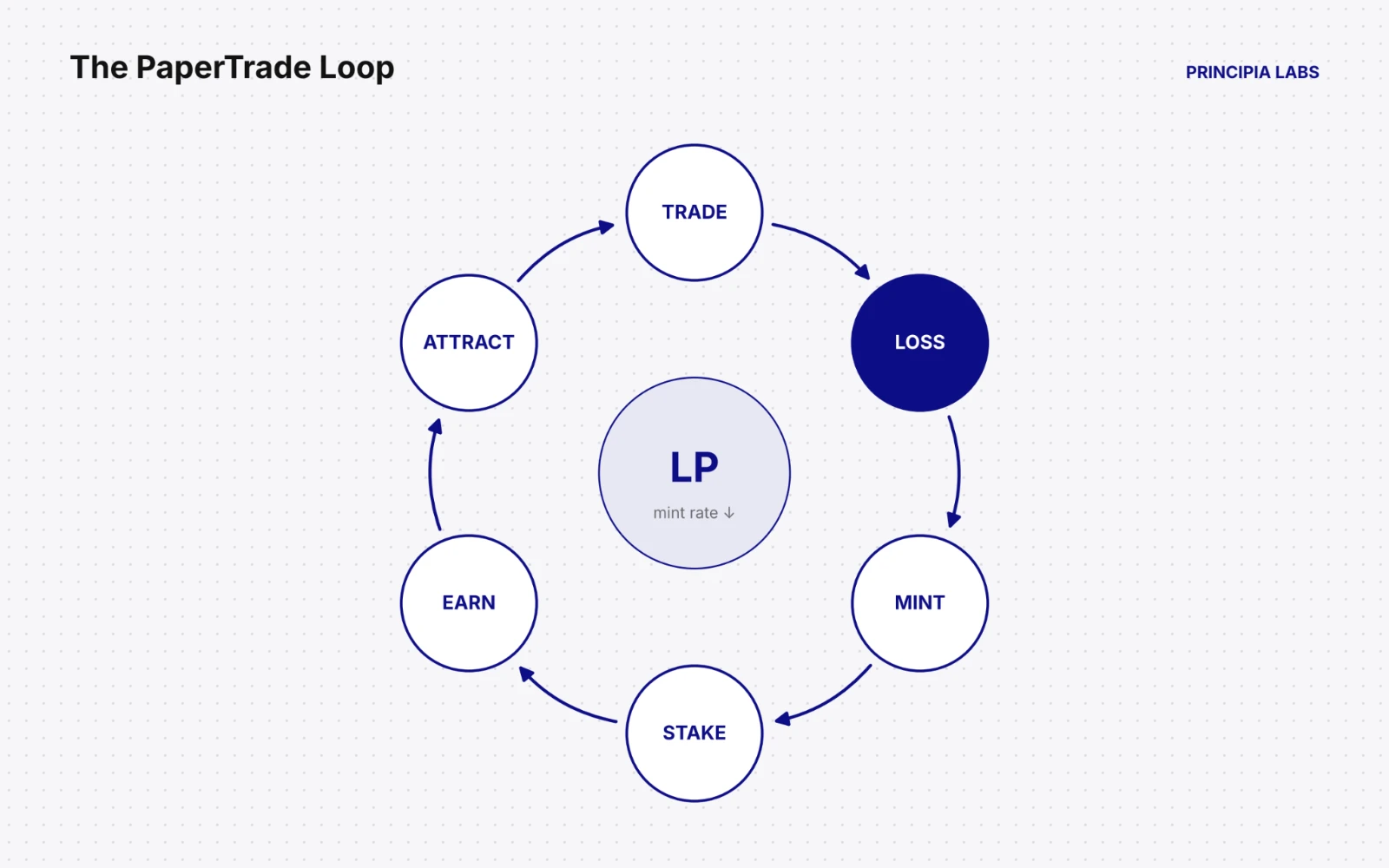
Trade → losses flow into the LP → losses mint PAPER → stake → stakers earn USDC → the yield draws in more traders (and farmers), and the loop starts over. The brake is that the mint rate only goes down, never up: with every turn, the same $1 of losses buys less PAPER, so the flywheel's thrust keeps weakening.
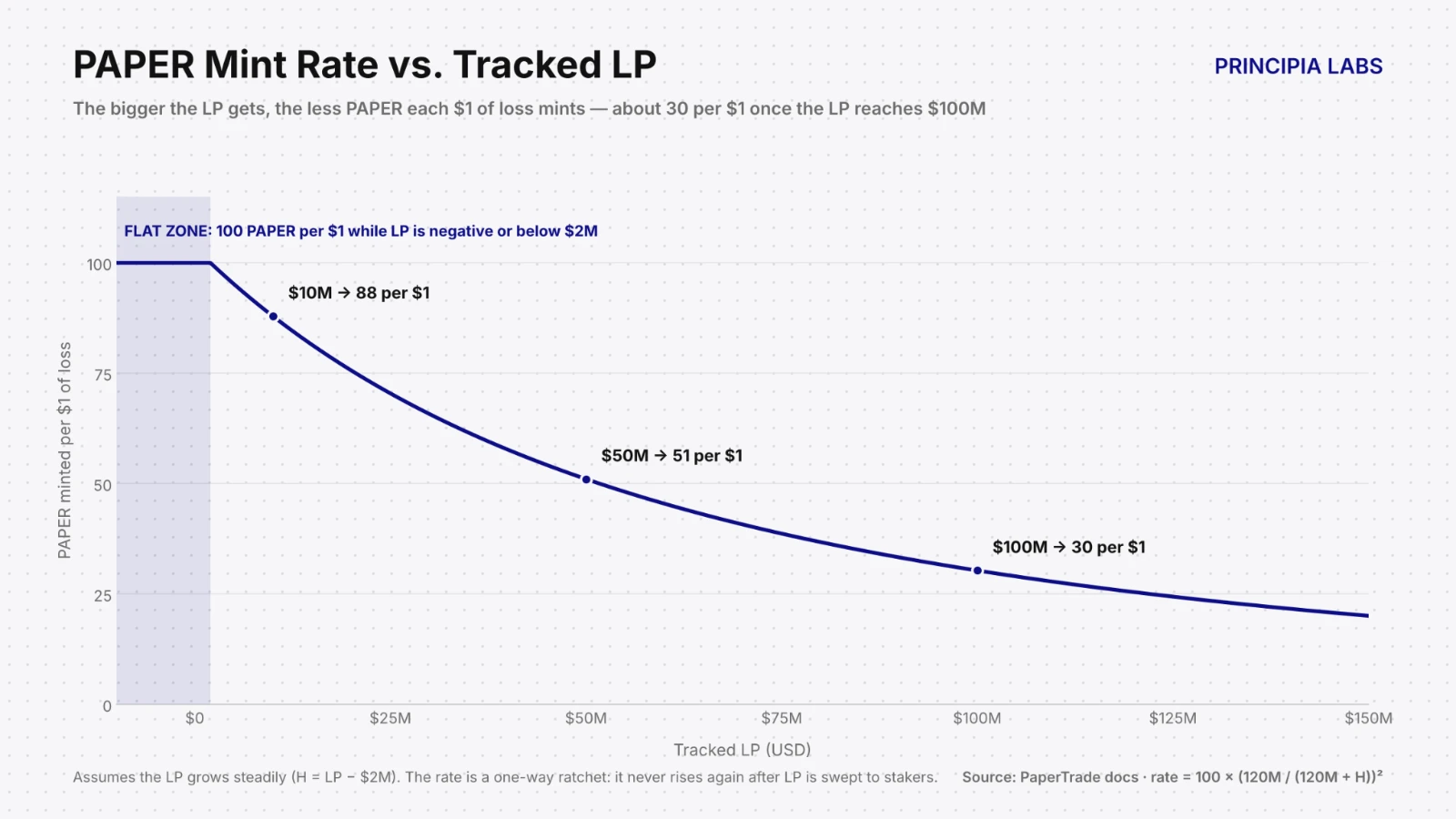
The bigger the LP, the less PAPER each $1 of losses mints: about 30 at an LP of $100M. The rate had already halved by the time the LP reached $50M, so early losing traders received 2–3× as much PAPER as later ones.
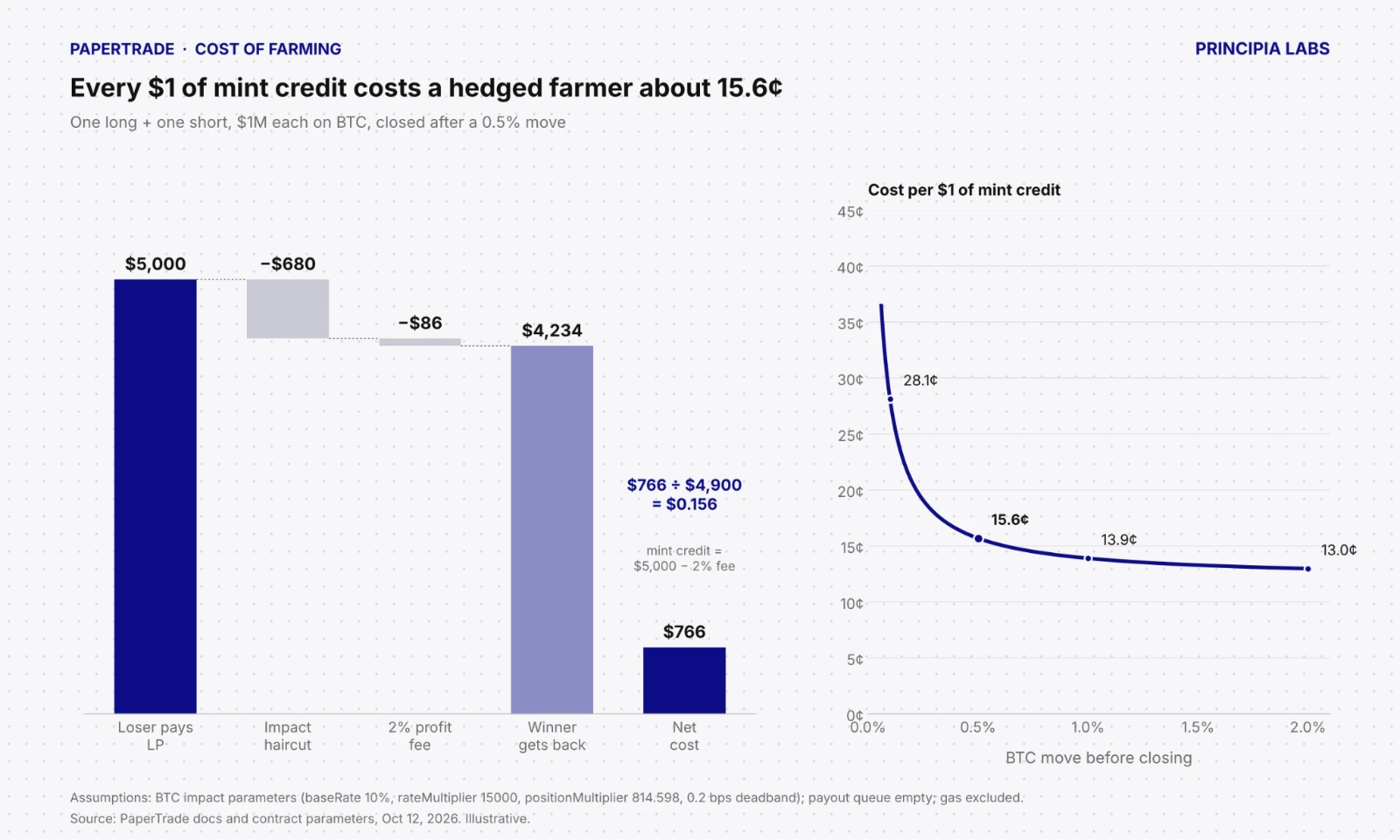
The average retail cost to farm one PAPER is $0.156. Returns come from two sources:
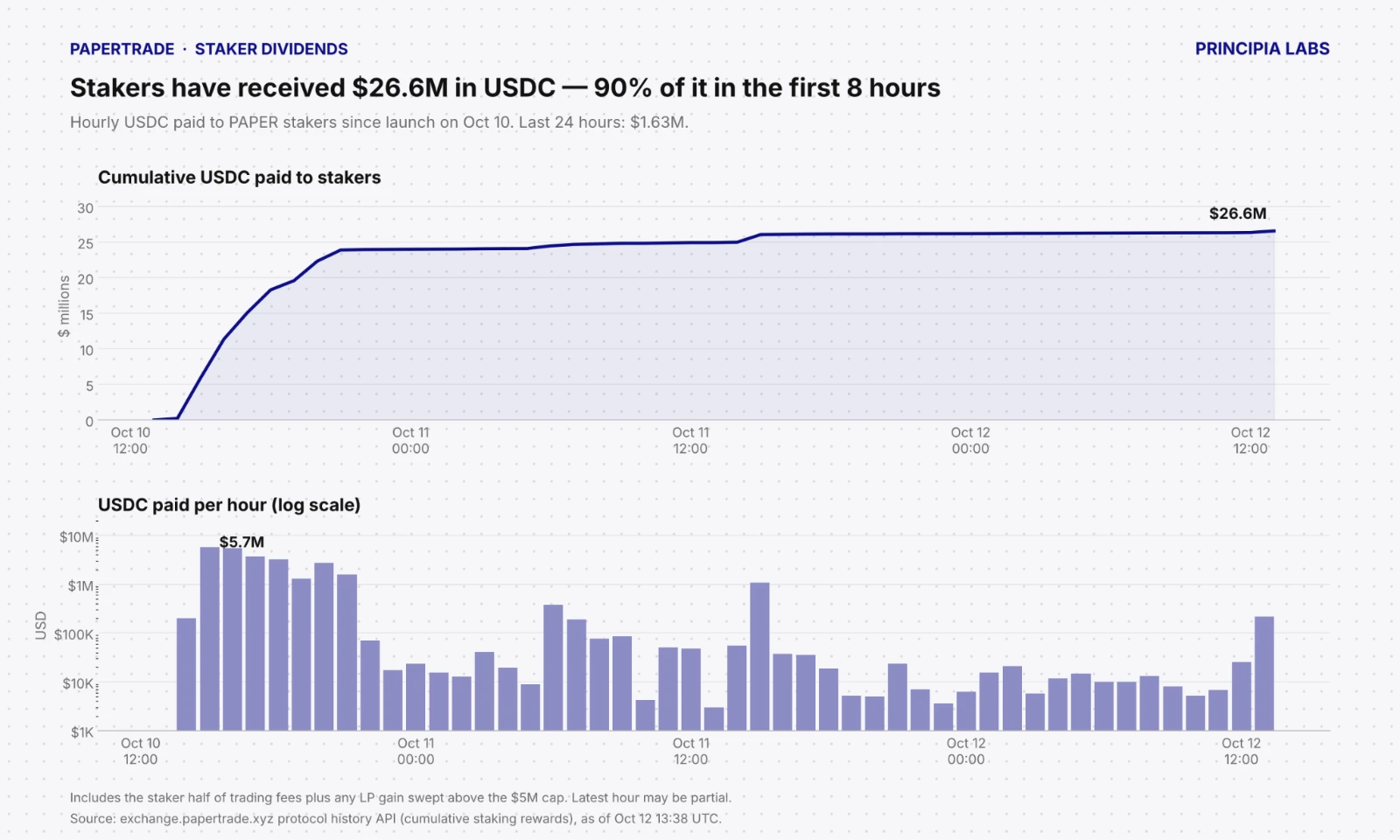
- Dividends while holding: today each PAPER earns about 0.027¢ a day, but dividends are falling extremely fast.
- Final token price: the price P you can sell at once transfers are enabled.
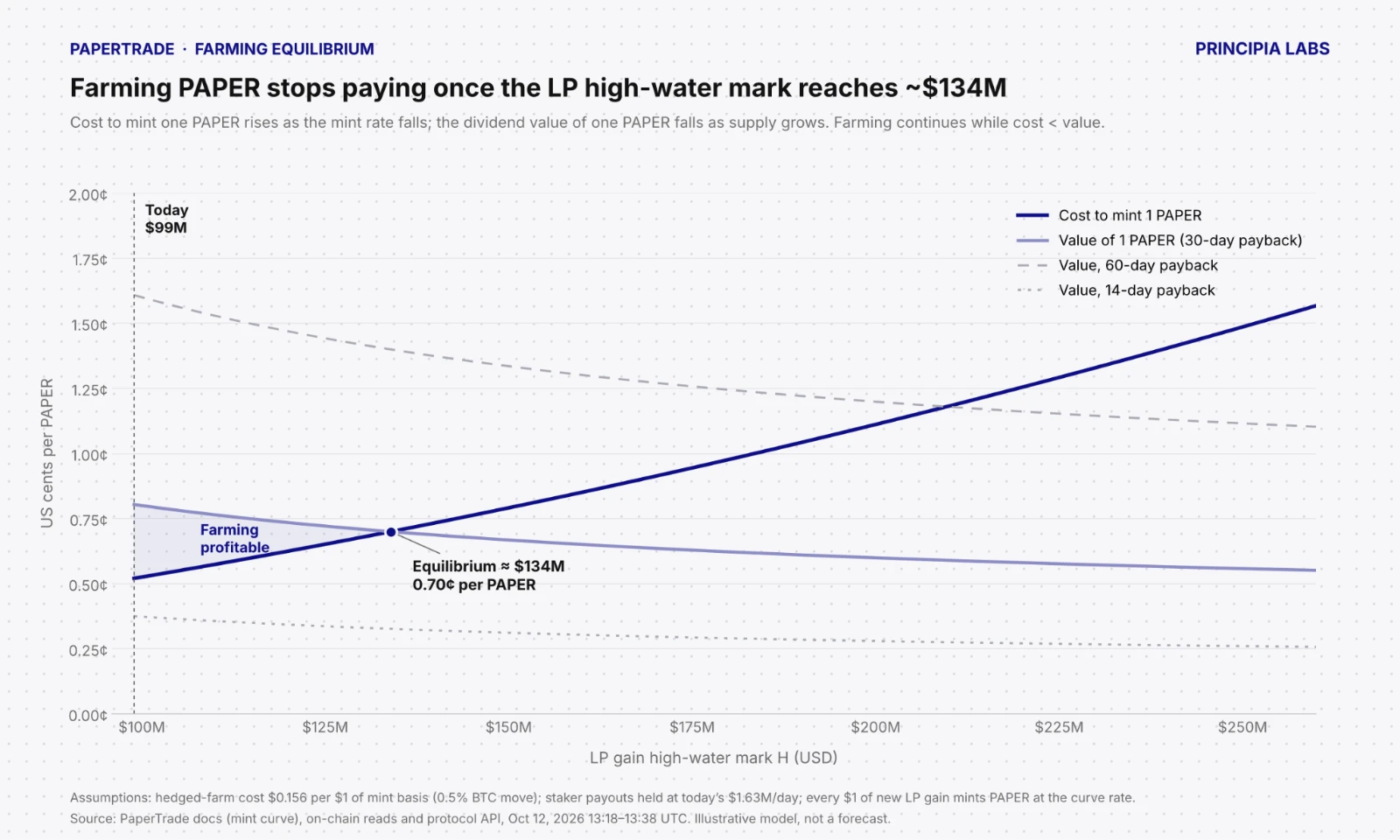
Before trading opens, we measure break-even by dividends; after trading opens, by token price. The chart above assumes dividends stay at today's $1.63M/day. Anyone who starts farming right now would need more than 14 days to break even — and as dividends keep declining, that payback period will keep stretching. Early participants spent a net ~$15M farming and received 6.1B PAPER (0.25¢ each on average); they have already collected ~$26.6M in dividends, so as a group they're already in the black.
The flywheel's engine has switched from "dividends" to "expectations of the future token price." Once secondary trading opens, the equilibrium is set by price:
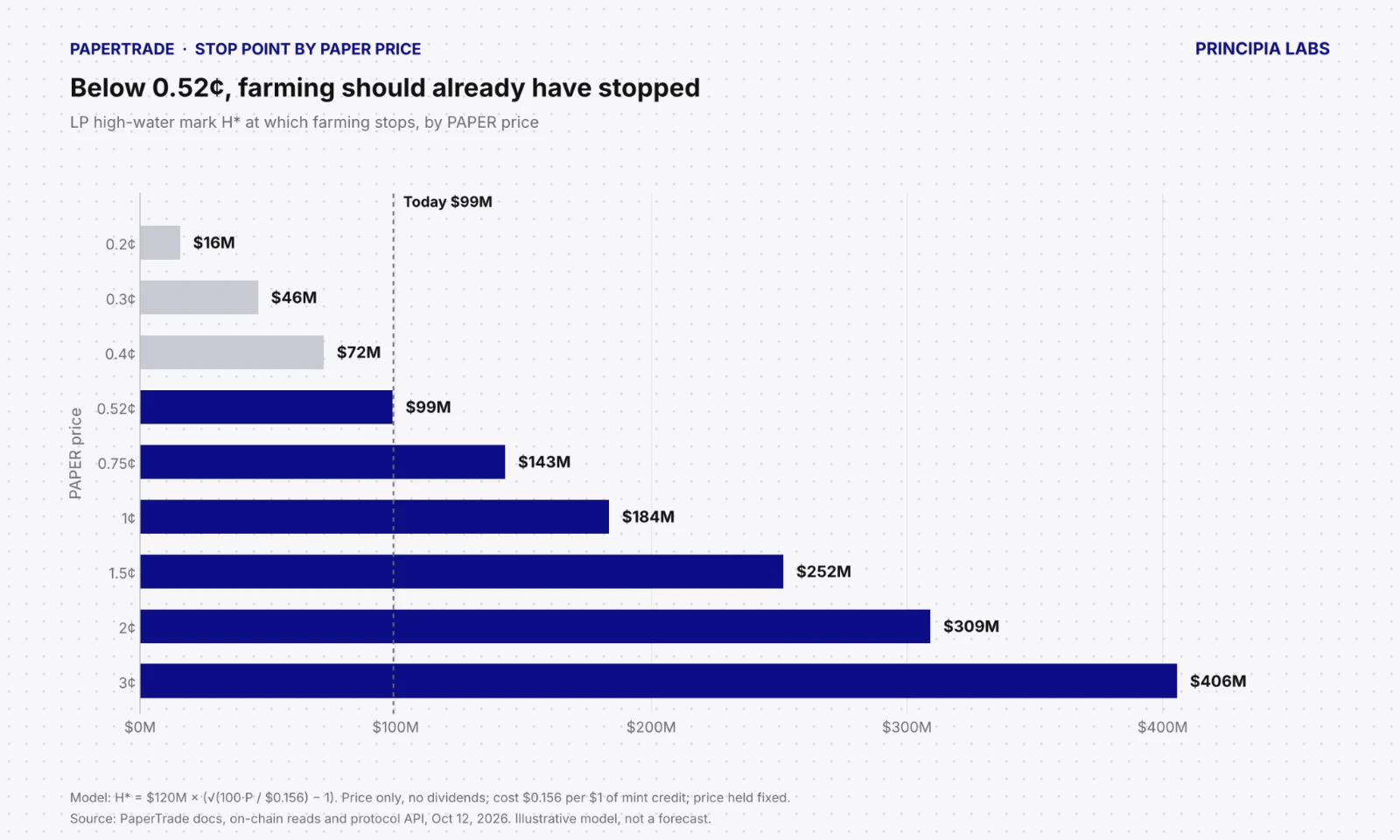
To date, the LP has collected about $99M from user losses, of which ~$26.6M has been paid out to stakers as USDC dividends. At today's mint rate, farming one PAPER costs about $0.0052 (0.52¢); across 6.1B tokens, that implies a break-even market cap of about $32M.
The later you farm, the lower the mint rate and the higher the token price you need to break even. Take the top tier in the chart: if the market values PAPER at $0.03 (3¢), that's a market cap of ~$182M on today's 6.1B supply, and farming stays worthwhile until the LP has accumulated about $406M.
We think PAPER's market cap after launch will very likely land well above the $32M break-even line, so there's still room to get in now. Risks to track:
- Dividends are falling fast and can no longer cover costs on their own; returns now depend almost entirely on the post-launch token price.
- Supply grows about 11% a day: the later you farm, the higher your cost, and tokens farmed early get diluted too.
- The 0.52¢ cost is optimistic: the faster you close positions, the higher your real cost.
- Launch timing and circulation rules are unknown; if many farmers sell on day one, price will come under pressure.
Risks
- Price manipulation: The team acknowledges there's no deviation circuit breaker on the BBO, so someone could place orders on the Hyperliquid book to distort the midpoint and arbitrage it.
- Centralized access: Positions can only be opened and closed through the official relayer; if the relayer goes down, users can't close positions themselves.
- Upgradeable contracts: The owner can upgrade the contracts; this is mitigated by a 7-day timelock and a 2-of-3 multisig.
- Fading demand: The mint rate has already dropped to about 1/3 of its starting level, weakening the incentive to farm; volume may keep sliding.
- Unlock selling pressure: Once PAPER becomes transferable, concentrated holdings could be sold all at once.
- User risk: 1000× leverage means hard liquidations, so retail traders get wiped out easily; a leaked session key could let an attacker drain an account through malicious trades.