Crypto Venture Capital Q3 2026
Bitcoin rose about 43% in Q3 2026, yet crypto venture funding kept cooling.
Principia Research, RootData · 2026.11.02 · Quarterly Report · VENTURE CAPITAL, FUNDRAISING, TRADFI · 9 MIN
TL;DR
Bitcoin rose about 43% in Q3 2026, yet crypto venture funding kept cooling. RootData logged 199 deals with $4.46B in disclosed capital, the fourth straight quarterly decline in deal count. The market hasn't stalled, but where the money goes, and who provides it, has shifted significantly.
- VC activity cooled across the board. Deal count fell 5% quarter over quarter and disclosed capital fell 24%.
- Capital moved to late-stage and strategic rounds. Strategic and private rounds took about $1.75B; early-stage rounds took only about $0.73B. Excluding public-company follow-ons, IPOs and de-SPACs, M&A, public token sales, OTC deals and debt, equity financing came to 144 deals and about $3.38B disclosed: up 12% QoQ and 35% YoY in dollars, but down 14% QoQ and 36% YoY in deal count. The 74% YoY drop in total funding mostly reflects a Q3 2025 base inflated by public-company raises and IPOs.
- The median rose, but large deals thinned out. The median disclosed round rose from $6.0M to $8.0M. Deals of $100M or more fell from 17 to 13, and the top 10 deals' share of disclosed capital fell from 62% to 57%. The biggest drop came in disclosed deals under $5M.
- Money went mainly to exchanges, brokers and other centralized finance companies. CeFi accounted for 31 deals and 32% of disclosed capital. DeFi had the most deals, 51, but only 8% of the capital.
- Deals backed only by crypto-native investors fell nearly 60%. Their disclosed capital dropped from $2.57B to $1.05B, while deals with TradFi or generalist participation rose from 39% to 45% of disclosed capital.
- The next funding cycle looks tight. Only three new crypto venture funds closed this quarter, raising about $1.3B in total, the fewest new funds since Q3 2019 (Galaxy Research).
1. Bitcoin Rallied, Venture Funding Cooled
RootData recorded 199 deals this quarter, 116 of which disclosed amounts totaling $4.46B. That is 5% fewer deals and 24% less capital than in Q2, and 74% less capital than a year earlier.
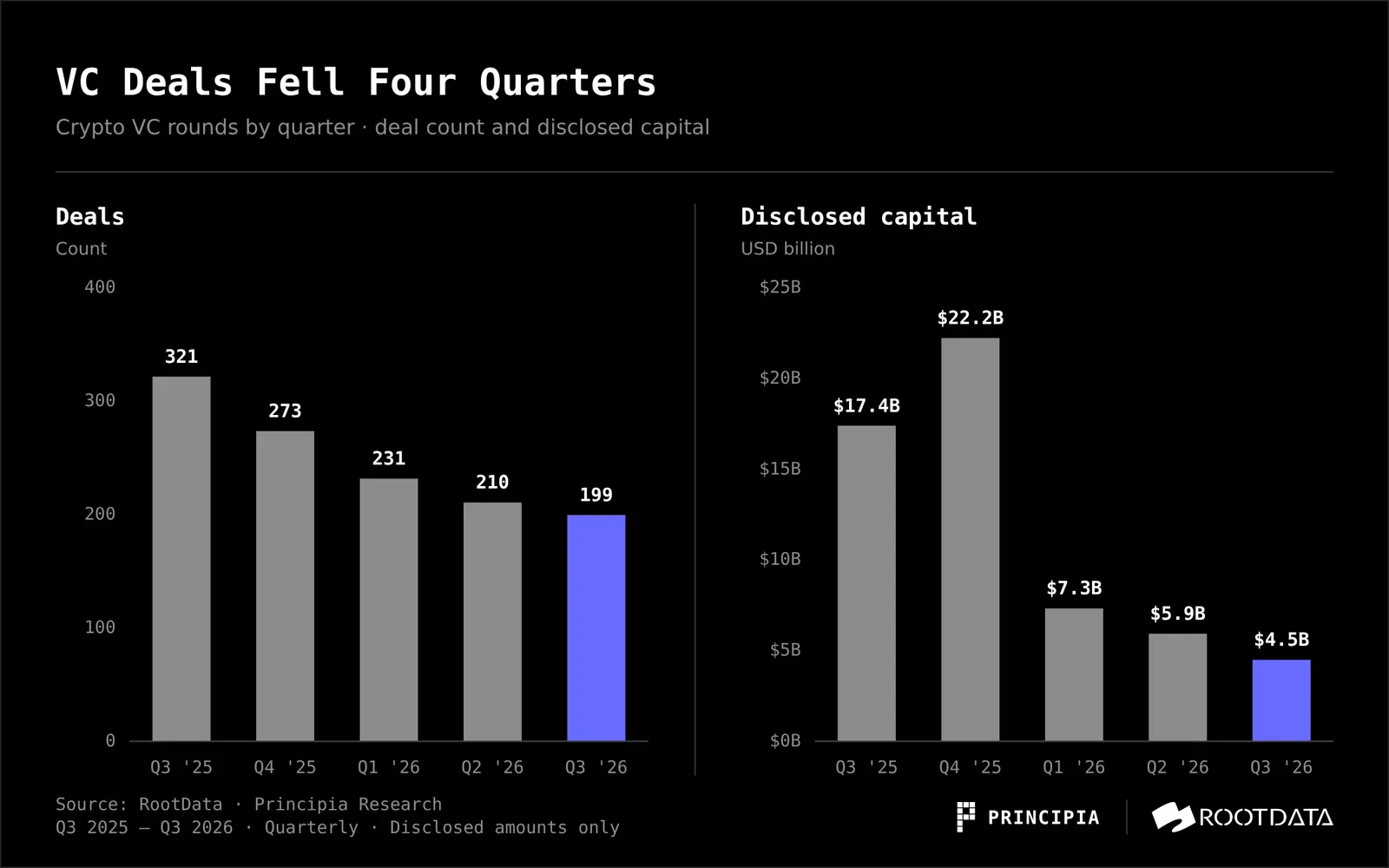
The Q3 2025 base was inflated by large public-company raises and IPOs: Strategy (about $2.52B), Forward Industries (about $1.65B), Galaxy (about $1.40B) and Bullish's IPO (about $1.11B). As that wave of crypto-equity financing receded, funding fell 74% year over year. Q4 2025's $22.19B was similarly lumpy: nearly half came from a single $10.3B Dunamu acquisition.
Equity financing alone tells the opposite story. We stripped out public-company follow-ons (Post-IPO), IPOs and de-SPACs, M&A, public token sales, OTC deals, debt and community rounds. We also removed unlabeled deals above $100M that we verified as secondary share sales, token presales, public-company raises or debt. What remains is 144 equity deals and about $3.38B disclosed in Q3, above Q2 (about $3.02B across 168 deals) and Q3 2025 (about $2.50B across 226 deals). That is up 12% QoQ and 35% YoY in dollars, and down 14% QoQ and 36% YoY in deal count. Fewer deals, but bigger checks.
More telling is the gap between prices and private funding. Bitcoin climbed from about $58.6K in early July to about $83.6K in early October, a gain of roughly 43%, yet venture funding did not follow. We think a key reason is AI's pull on capital. Compute and model development need enormous sums, and the market expects more upside from AI. With LP allocations finite, some capital that once went to crypto venture is moving to AI. Moves by leading crypto-native firms back this up. On July 8, Paradigm announced its $1.2B fourth fund, expanding beyond crypto into AI, robotics and other frontier areas while saying it will keep investing in crypto. IOSG founding partner Jocy Lin launched IOSF Ventures, which focuses on AI. And on October 22, a16z Crypto renamed itself a16z Frontier, widening its new fund's scope to AI, autonomous machines and other frontier technologies while continuing to invest in crypto.
Swings within the quarter came down to a handful of large deals. July was the busiest month, with $2.37B across 72 deals, as Crypto.com, Ionic Digital and Securitize each raised $400M. August was the quietest, with $0.72B across 63 deals. September recovered to $1.37B across 64 deals, driven mainly by Polymarket's $300M and Félix's $200M.
2. Capital Shifted to Late-Stage and Strategic Rounds
Strategic and private rounds took nearly 40% of the quarter's capital, about $1.75B. Early-stage rounds led on deal count but took only about one-sixth of the dollars.
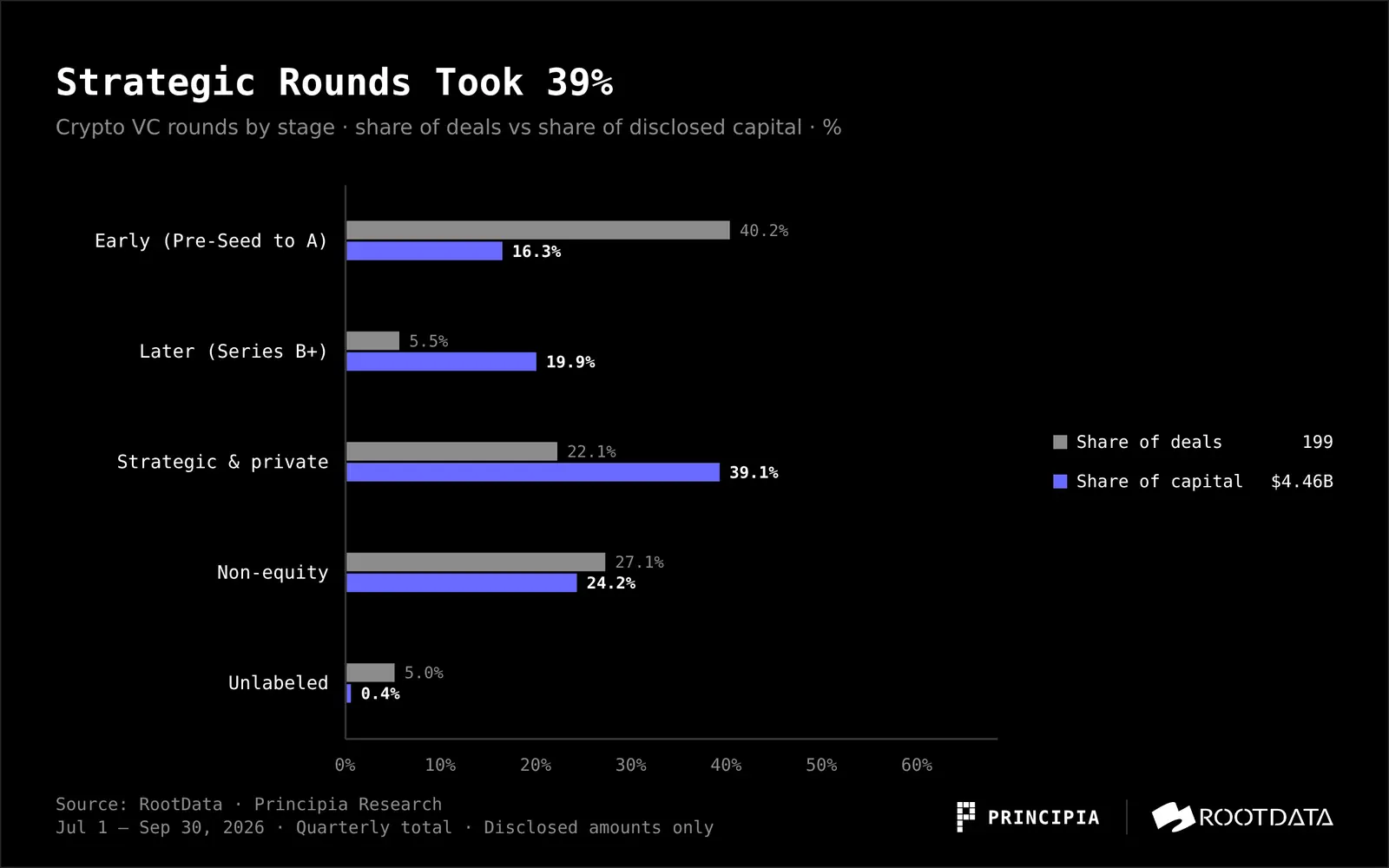
Early stage was still the most active, with 80 deals, about 40% of the total. In dollar terms, though, it played a supporting role: everything outside early-stage rounds took roughly 84% of disclosed capital.
By round size, mid-sized deals ($20M to $100M, excluding $100M) numbered 25 this quarter with about $1.15B disclosed, up from 19 deals and about $0.77B in Q2. But seven of those Q3 deals were OTC, debt, public-company follow-ons or M&A. Counting equity only, the mid-sized bracket had 18 deals and about $0.87B. That is flat with Q2 on count (18 deals, about $0.73B), up about 19% in dollars, and still below Q3 2025 (31 deals, about $1.03B).
This reflects more than lower risk appetite; the investor base itself is changing. Some crypto-native investors have stopped new investments, wound down or pivoted to AI. In December 2025, after the SEC sued Shima Capital, its founder reportedly told portfolio founders in an internal email that he was stepping down and the fund would be wound down in an orderly way. In June 2026, AGV, the gaming investment program under the Arbitrum DAO, proposed halting new investments and managing only its existing portfolio. The proposal passed in early July, and about 143.7M ARB will be returned to the DAO treasury in stages. In October, Deus X Capital ceased operations ahead of a formal liquidation on January 31, 2027, and CEO Tim Grant became CEO of AI company TensorX. At the end of that month, stablecoin infrastructure investor Verda Ventures stopped making new investments after its founders joined Tether, and will now support only its existing portfolio.
Meanwhile, TradFi and strategic capital are filling the gap. Citadel Securities invested $400M in Crypto.com at a $20B valuation. Nasdaq Ventures agreed to invest $100M in Payward, Kraken's parent, at a valuation of about $21B according to Bloomberg. 1789 Capital led an approximately $1B round in Polymarket, contributing about $300M at a $21B valuation. Tiger Global led Augustus's $180M Series B, and SBI Holdings led both EDX Markets' $76M Series C and Gauntlet's $125M Series C. This money is going to licenses, clearing and trading access, where the outcomes are more certain and compliant, rather than to new narratives.
3. Sectors: Capital Is Buying Financial Plumbing
By RootData's primary tags, CeFi ranked first with 31 deals and $1.44B, or 32% of disclosed capital. DeFi had the most deals, 51, but only $0.37B, or 8%.
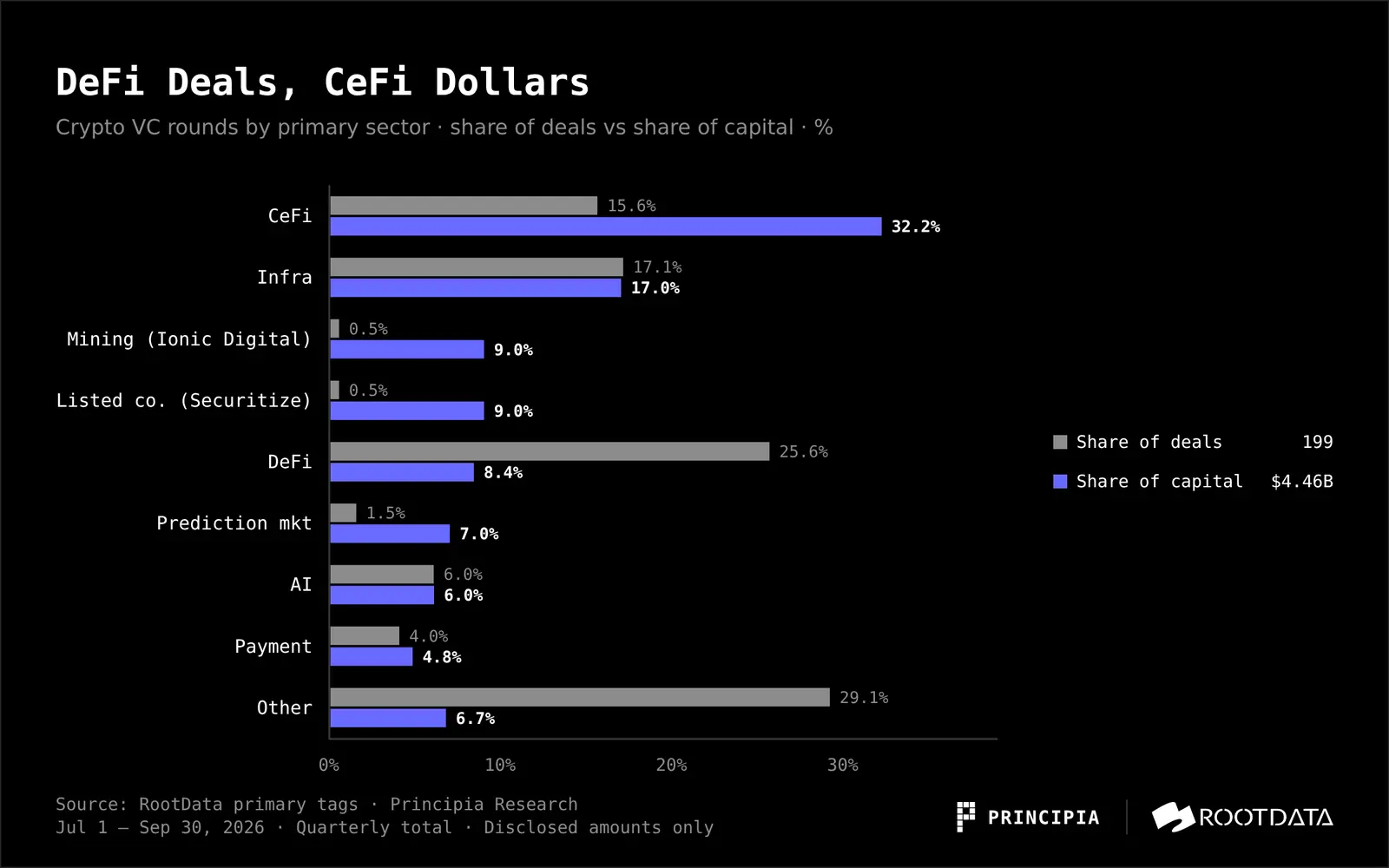
Nearly all of CeFi's large deals were trading, brokerage and clearing businesses: Crypto.com, Kraken, Augustus, Alpaca and EDX Markets. Infra ranked second with 34 deals and $0.76B, led by Ripple (Ripple Prime's $275M senior unsecured notes), Prime Intellect and Gauntlet. Two other $400M deals each carried a tag on their own: bitcoin miner Ionic Digital, and Securitize, which listed on the NYSE via a SPAC.
DeFi's low dollar total partly reflects thin disclosure: only 25 of its 51 deals disclosed an amount. Even so, DeFi clearly skewed toward small, early-stage, protocol-level deals. Consumer was nearly absent: gaming had just three primary-tag deals totaling about $5.9M.
4. Crypto-Native-Only Deals Fell Nearly 60%
Disclosed capital in deals backed only by crypto-native investors fell from $2.57B last quarter to $1.05B, and their share dropped from 44% to 24%. Deals with TradFi or generalist participation rose from 39% to 45%.
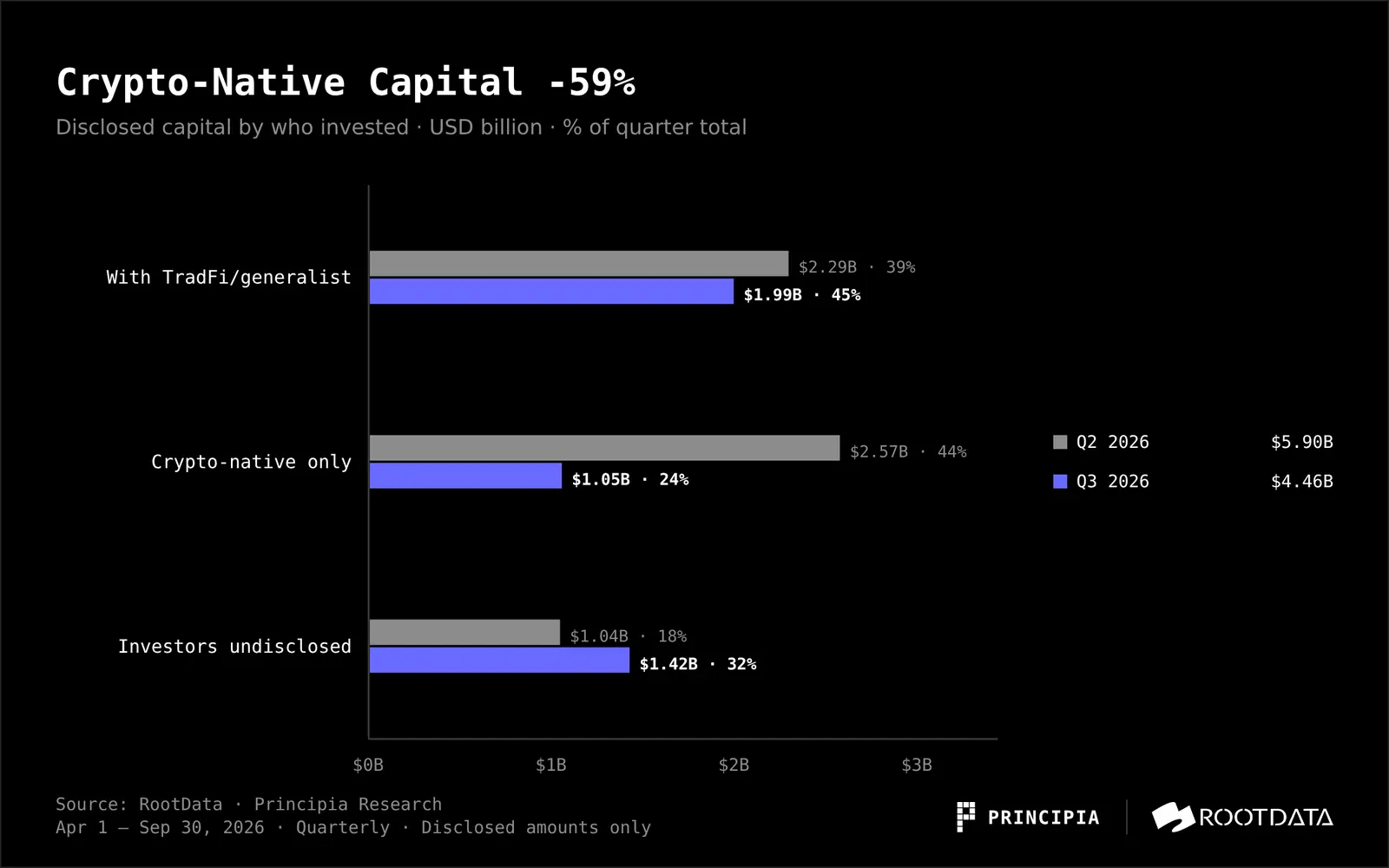
"TradFi or generalist capital" covers banks, exchanges and market infrastructure, brokers, asset managers, big tech, trading firms, and multi-sector or fintech VCs. Crypto-native capital is retreating, while the quarter's largest deals were backed by Citadel Securities, Nasdaq, 1789 Capital, Tiger Global, Peak XV, SBI, Intel Capital and ICONIQ.
By deal count, the picture looks different. The most active investors were YZi Labs and Coinbase Ventures, but both mainly incubate and follow on, and rarely lead.
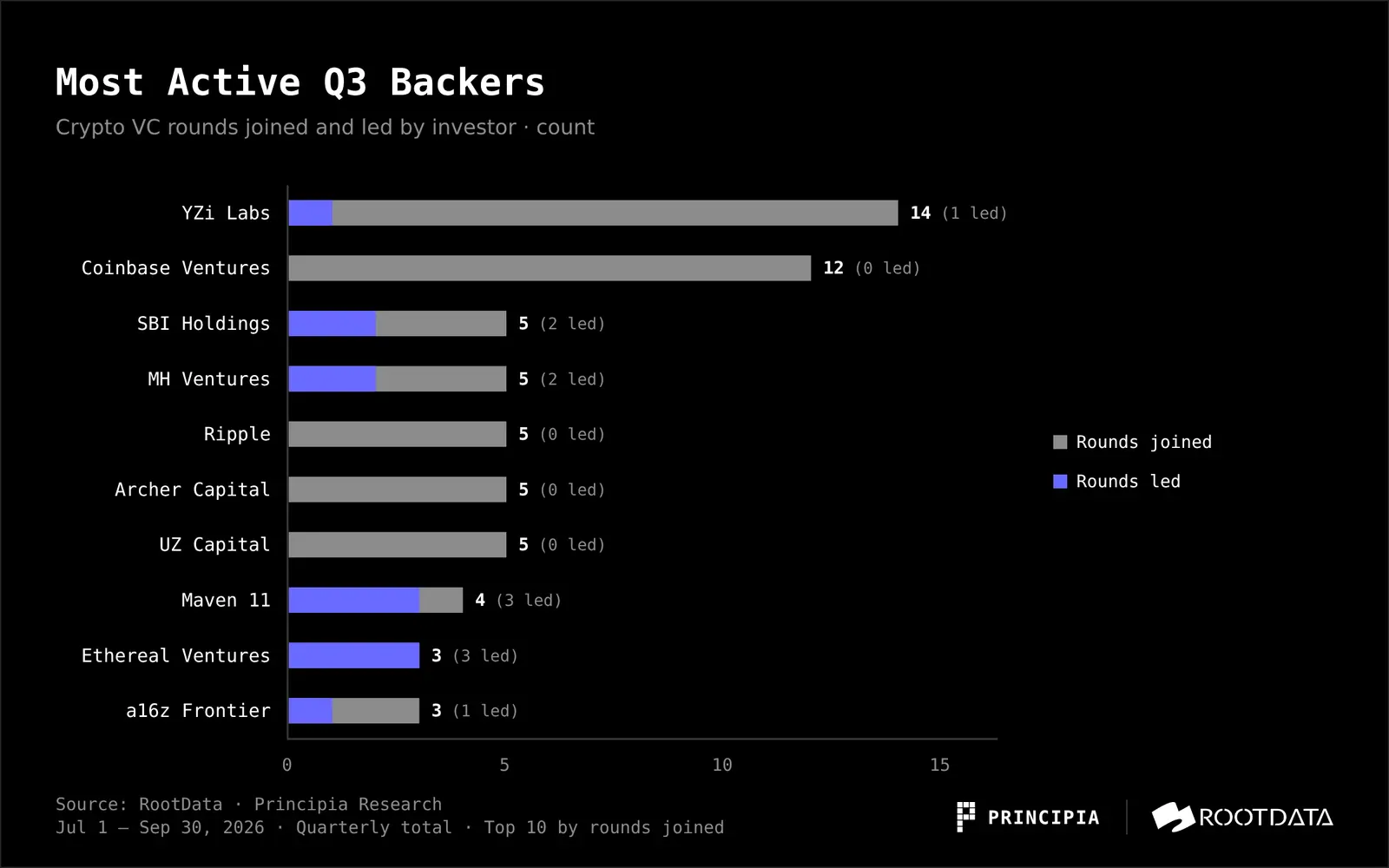
Leadership has shifted since Q2. Back then the most active investors were Coinbase Ventures (13 deals), Animoca Brands (12) and a16z Frontier (formerly a16z Crypto, 8), and Paradigm led four rounds. This quarter, pricing power moved further toward the TradFi institutions named above.
5. Newer Companies Did More Deals, Older Ones Raised the Money
Companies founded in 2021 or earlier raised $2.30B across 51 deals, more than half of disclosed capital. Companies founded in 2025 or later did the most deals, 67, but raised only $0.63B.
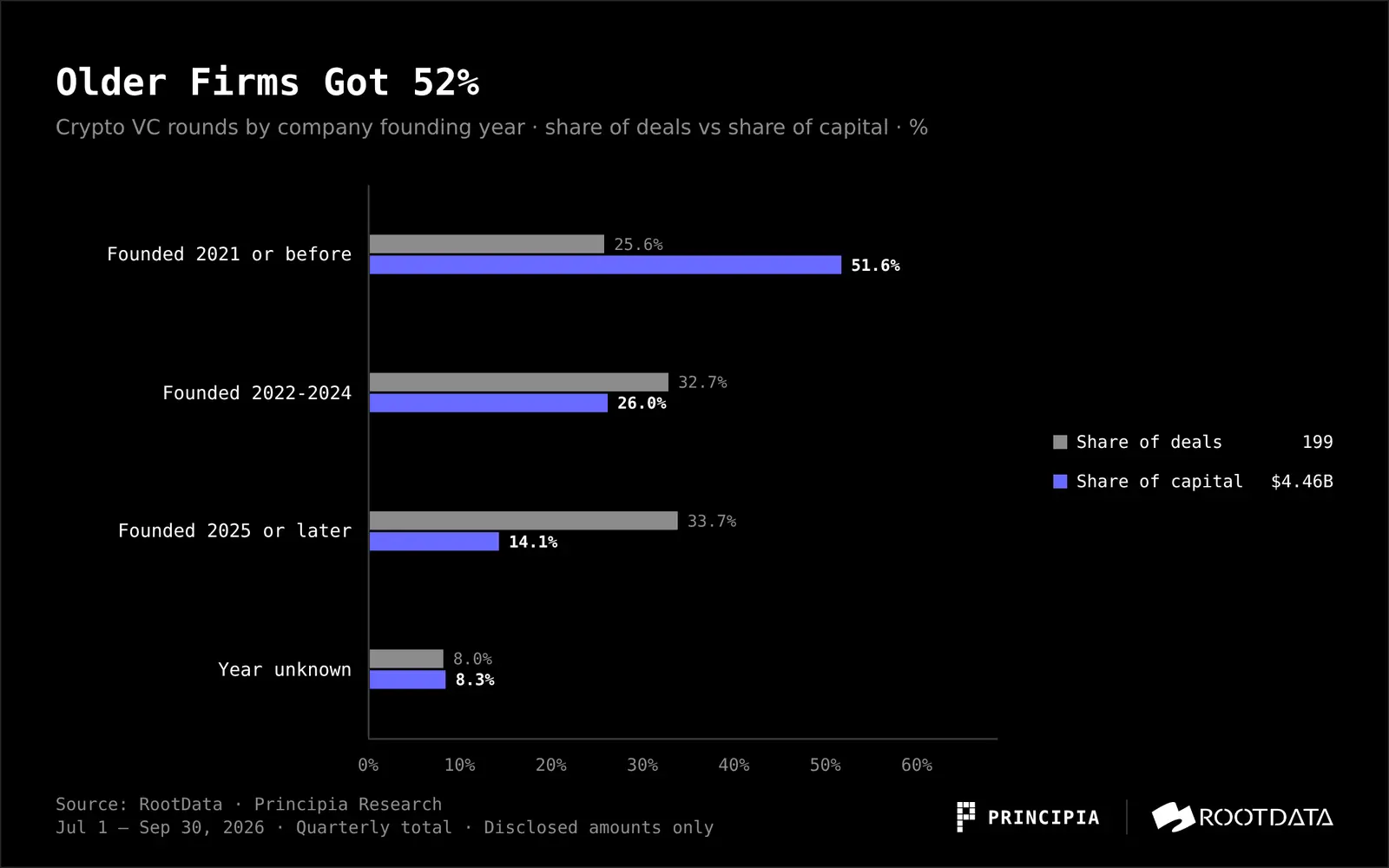
The older names behind the big rounds are familiar: Crypto.com (founded 2016), Kraken (2011), Ripple (2013) and Securitize (2017). They have revenue, licenses and businesses that can be valued, which is exactly what capital favored this quarter.
6. Geography: The US Still Dominates
RootData's country field covers only 53 of 192 projects (28%), or 55 deals and $2.19B, about half of disclosed capital. Within that sample, the US accounted for 28 deals and $1.52B, and Singapore for 10 deals and $444M, $400M of it from Crypto.com alone.
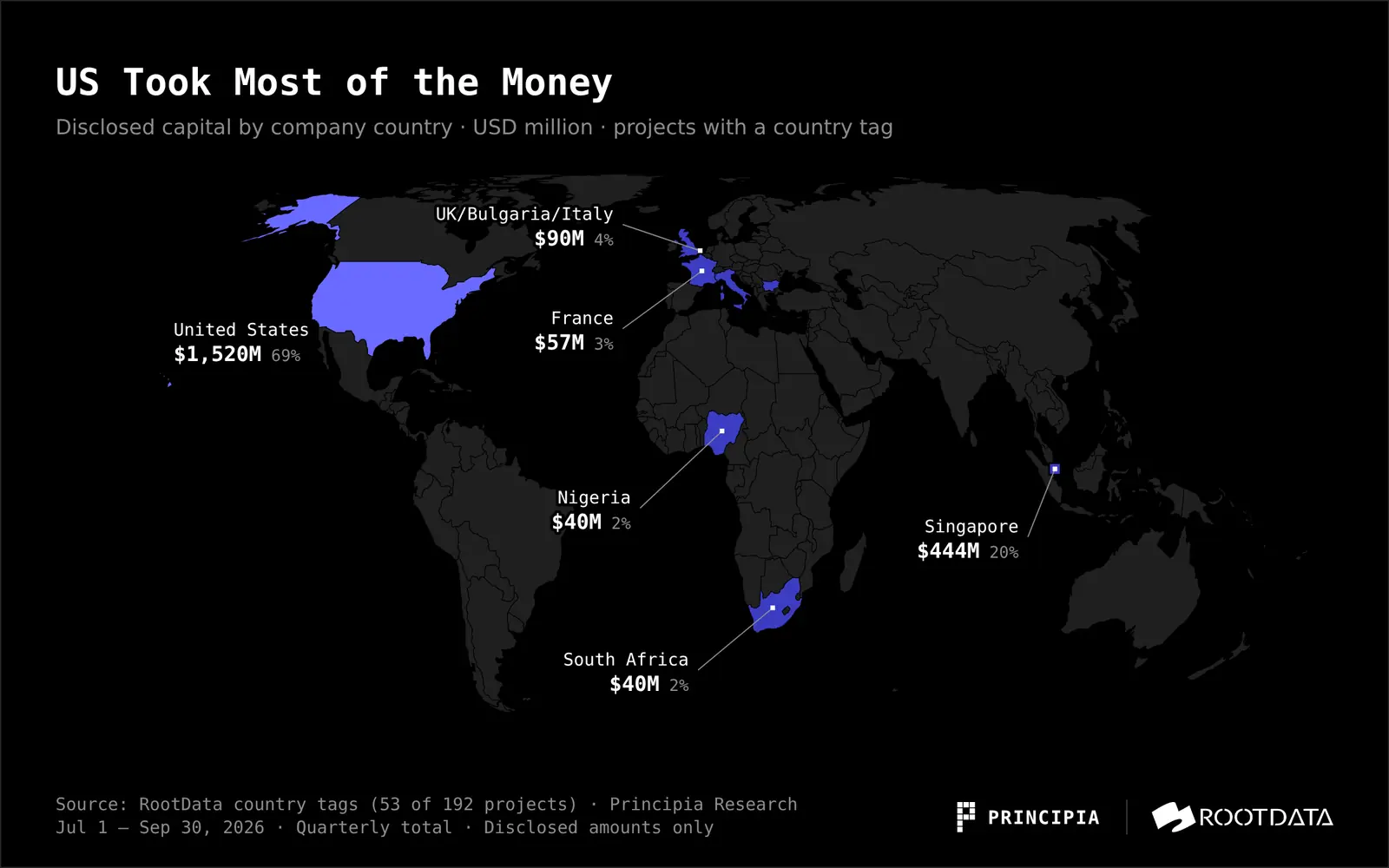
Other countries were scattered. The UK, Bulgaria and Italy each registered $90M, France $57M, and Nigeria and South Africa $40M each; Hong Kong (3 deals) and Japan (2) were small. Coverage is thin, but the data still points to capital heavily concentrated in the US, with Asia's large deals coming mostly from Singapore-based exchanges.
7. Fundraising: Less Dry Powder Ahead
How much the private market can invest ultimately depends on how much funds can raise. According to Galaxy Research, only three new crypto venture funds closed this quarter, raising about $1.3B in total, the fewest new funds in a quarter since Q3 2019. Annualized, this year's fundraising comes to about $8.2B, slightly below 2025's $8.75B. The average fund size year to date is about $386M, but the median is just $71M: most new funds are small, and a few large ones pull up the average.
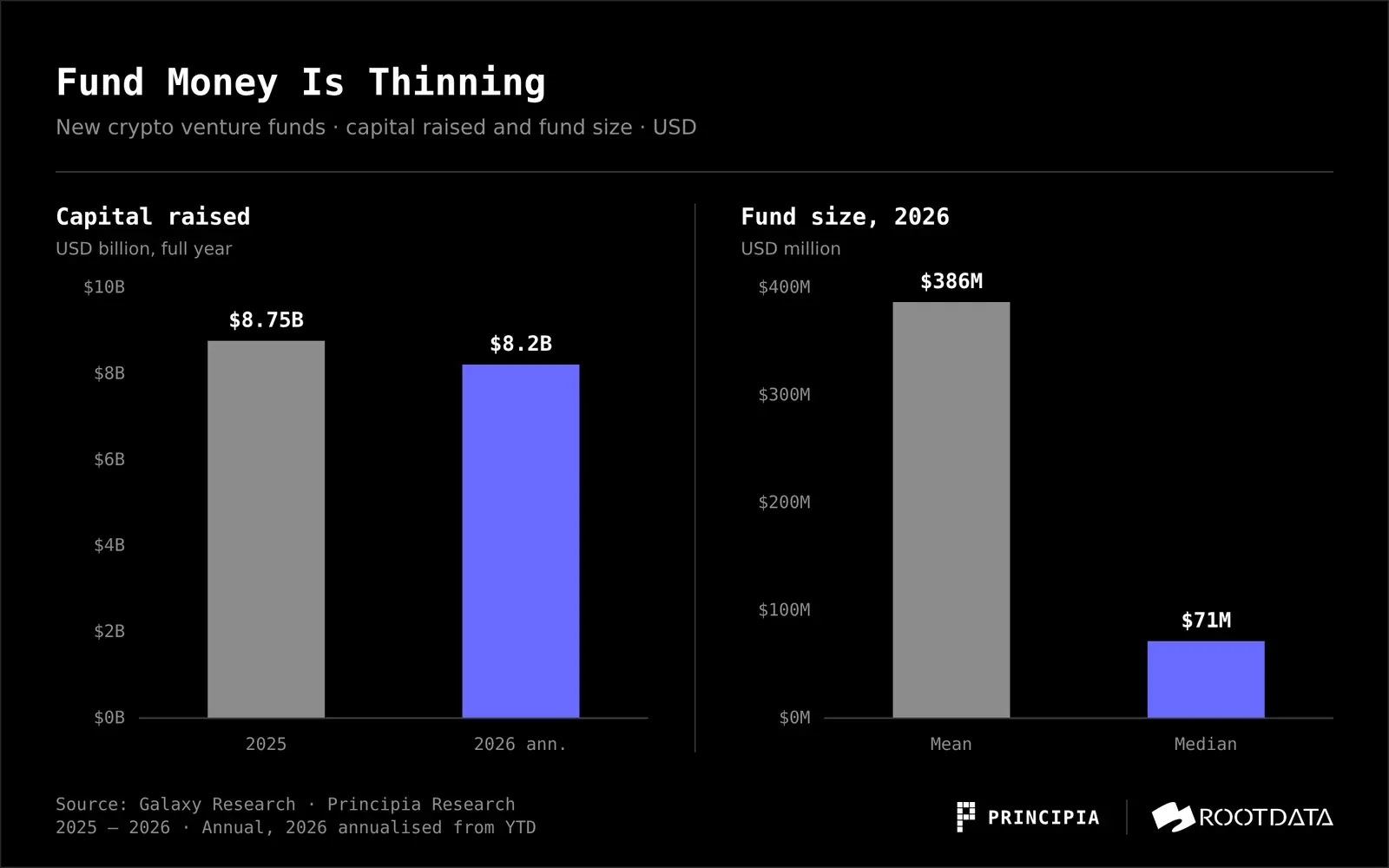
Harder fundraising and cooler deployment are two sides of the same coin: spot ETFs, digital asset treasury companies and AI are all competing for LP allocations. Our view is that tighter LP funding will make GPs more cautious. They will prioritize follow-on rounds for existing portfolio companies and lean toward companies with revenue and licenses, which is exactly the pattern we saw on the investment side this quarter.
8. Conclusion
Overall, VC activity cooled in Q3. Capital flowed to financial plumbing that can earn fees, hold licenses and clear trades, and pricing power shifted increasingly to TradFi institutions. With LP fundraising cold, the outlook for startups' follow-on rounds is not encouraging.
For founders, large rounds now come later, and the bar looks more like that of a mature company: revenue, licenses and distribution earn valuation more than narrative does. Early-stage funding has dropped sharply and VC risk appetite has fallen, so founders should be ready to lead with product data and accept smaller first rounds.
For investors and LPs, the price recovery has not flowed through to private markets. Bitcoin rose about 43% this quarter, yet funding kept falling; the old playbook of "prices up, venture booms" is not working for now. Mid-sized deals ($20M to $100M) grew in dollar terms quarter over quarter, but equity deal count was flat, so more quarters of data are needed to confirm a trend.
What to watch in Q4:
- Whether TradFi keeps showing up. Deals with TradFi participation accounted for 45% of disclosed capital this quarter. Q4 will show whether this is a structural shift or a few large deals lining up.
- Whether higher prices reach early-stage rounds. Only a rebound in the number of small early-stage rounds would signal a real recovery for founders.
- Policy and fundraising. Progress on the CLARITY Act, and whether new funds can close before year-end.
Sources
- Galaxy Research: Crypto and Blockchain Venture Capital – Q3 2026 (October 28)
- Galaxy Research: Charts of the Week: VC Vital Signs (October 23)
- Crypto.com: Crypto.com Announces $400 Million Strategic Investment from Citadel Securities
- Nasdaq: Nasdaq announces investment in Payward; valuation per CoinDesk, citing Bloomberg
- Paradigm: Announcing Our Fourth Fund
- a16z: a16z Frontier
- IOSF: iosf.vc
- Augustus: CoinDesk: Augustus raises $180M at a $1B valuation
- EDX Markets: EDX Markets Closes $76 Million Series C Led by SBI Holdings
- Gauntlet: Gauntlet Closes $125 Million Series C Led by SBI Holdings
- Polymarket: CoinDesk: 1789 Capital leads ~$1B Polymarket raise
- Ripple: Ripple Prime Closes $275 Million Senior Notes Offering
- Securitize: The Block: Securitize completes SPAC merger and lists on the NYSE
- Dunamu: The Korea Times: Hana Financial buys Dunamu shares from Kakao Investment
- Shima Capital: Cointelegraph
- AGV: Arbitrum Forum: AGV Wind-Down
- Deus X Capital: CoinDesk
- Verda Ventures: KuCoin News (via MarsBit)