Fundamentals of X Layer Q3 2026
Q3 was the quarter X Layer began turning from “an exchange’s chain” into “an exchange onchain.”
Principia Research, TokenInsight · 2026.10.21 · Quarterly Report · OKB · L2, OKX, EXCHANGE OS · 13 MIN
Key Takeaways
- TradeZone processed 287M transactions in Q3, 2.6x the X Layer EVM. Q3 traffic came from two simulated prediction seasons settled in XP points (the World Cup and Outcomes League Season 2). It demonstrated Exchange OS’s capacity for high-concurrency trading.
- EVM daily transactions hit 1.22M (+262%) and daily active addresses 70.5K (+89%), both five-quarter highs. Growth came mainly from returning users, whose share of daily actives rose from 75% to 91%. On Sep 11, for example, about 40% of daily actives were users sending stablecoins gas-free.
- DeFi TVL doubled to $173M and hit an all-time high of $187M on Sep 28. The main driver was a Pendle PT-USDG loop on Aave, which lifted Aave borrowing 7.5x and utilization to 40%. Where that capital goes after the PT matures on Oct 29 is the first thing to watch in Q4.
- X Layer is USDG’s largest chain, home to nearly half of its supply. The share of stablecoins deployed in DeFi rose from 4.7% to 11%. With 83% of USDG still in OKX wallets, bringing it into DeFi is X Layer’s shortest path to growth.
- RWA and institutional adoption are accelerating. xStocks on X Layer reached a $173M market cap in September, Circle launched native USDC, and the ICE–OKX joint venture plans to trade more than 60 tokenized US stocks on X Layer, starting as early as November.
- OKB rose 53.8% to $121 as its value accrual shifts. Q3 onchain fees grew 368% QoQ. More importantly, Exchange OS makes OKB the stake required to launch markets onchain, moving its value anchor from fees to the size of the entire onchain trading market.
Key Metrics
Network Data
Financials: OKB and Onchain Revenue
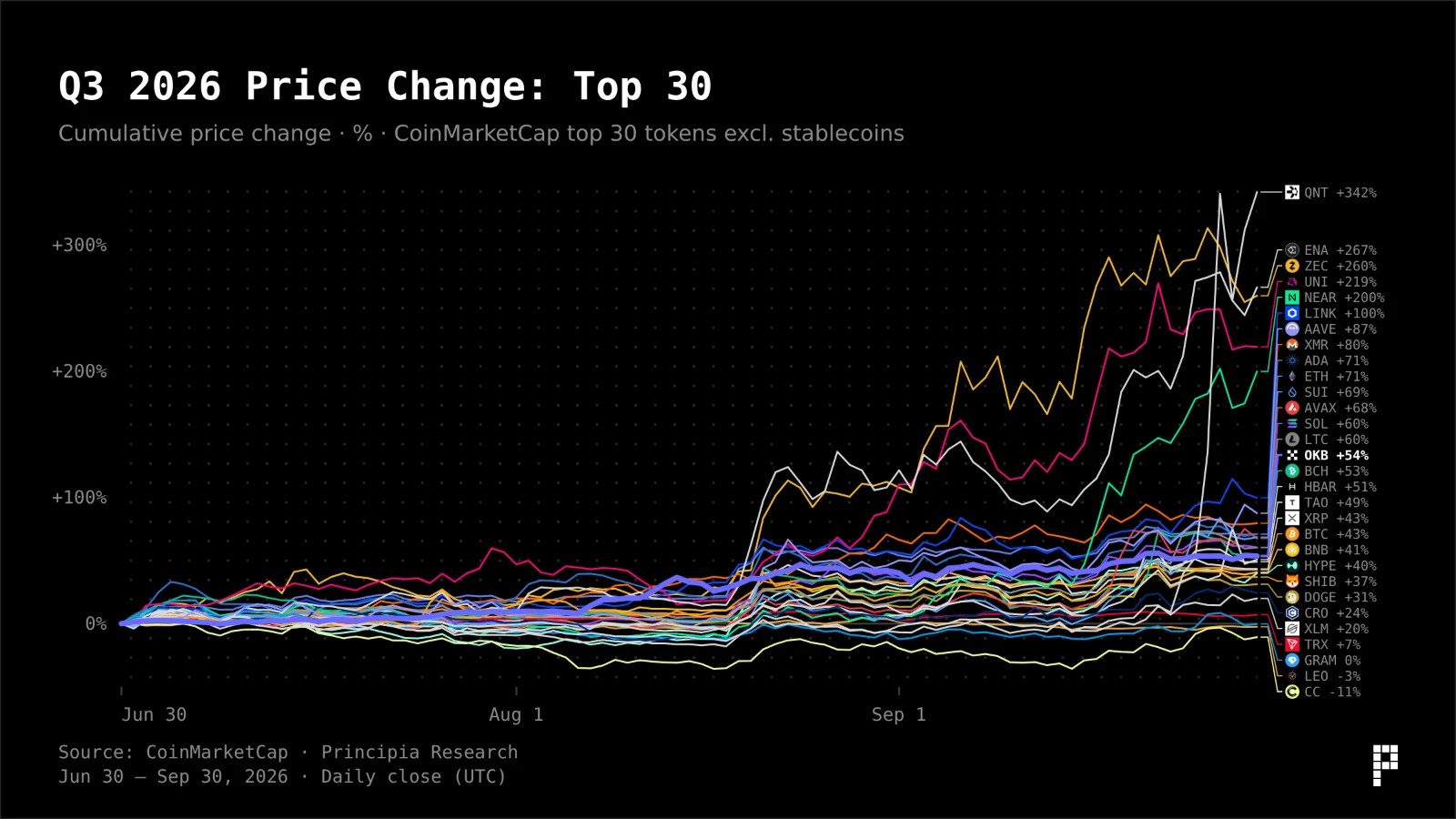
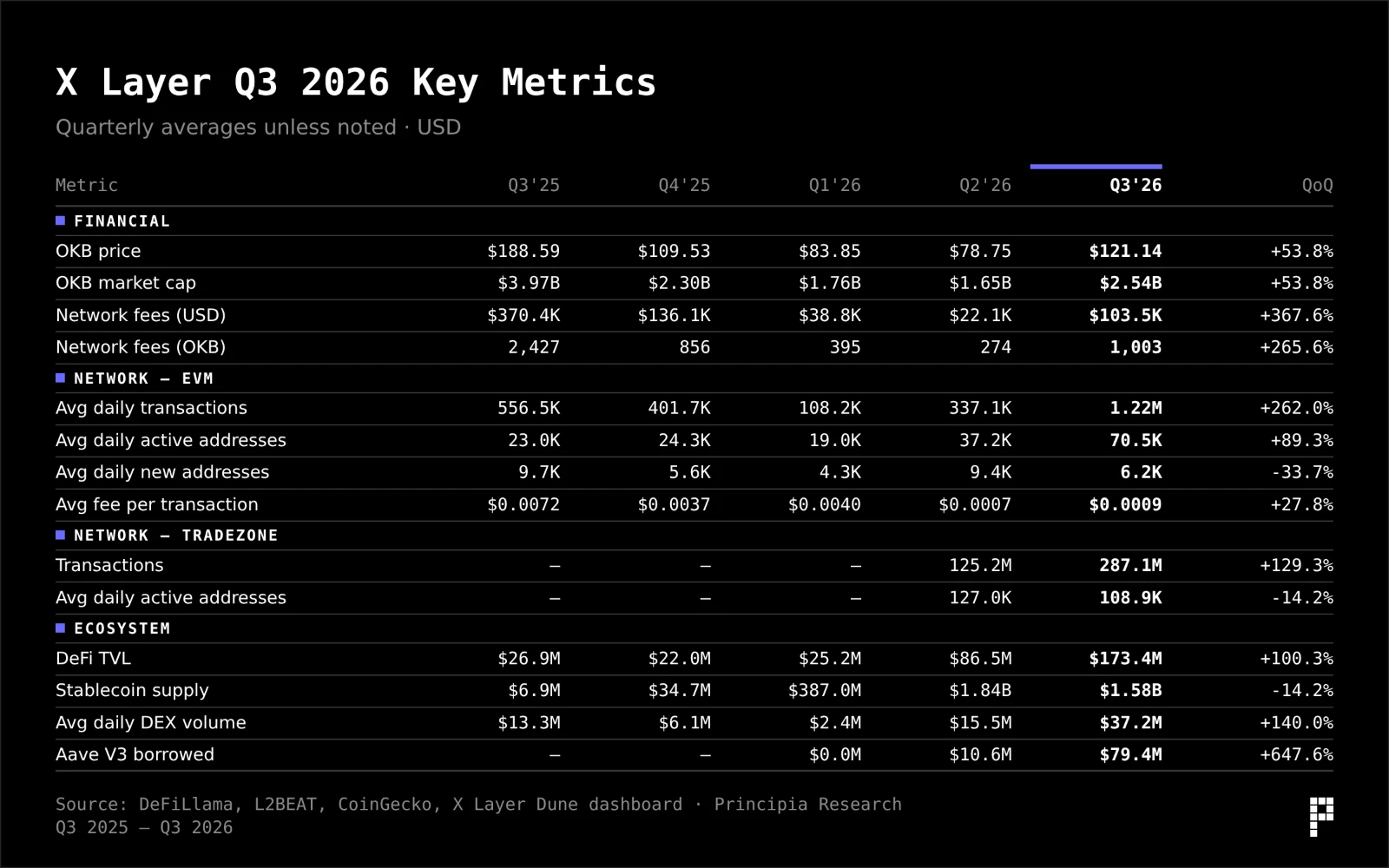
OKB closed Q3 at $121.14, up 53.8% QoQ, for a circulating market cap of $2.54B. Total supply is fixed at 21M OKB, so circulating market cap and fully diluted valuation (FDV) are the same. Onchain fees grew sharply: $104K in Q3, up 368% QoQ, or 1,003 OKB, up 266%.
EVM: Activity Doubled
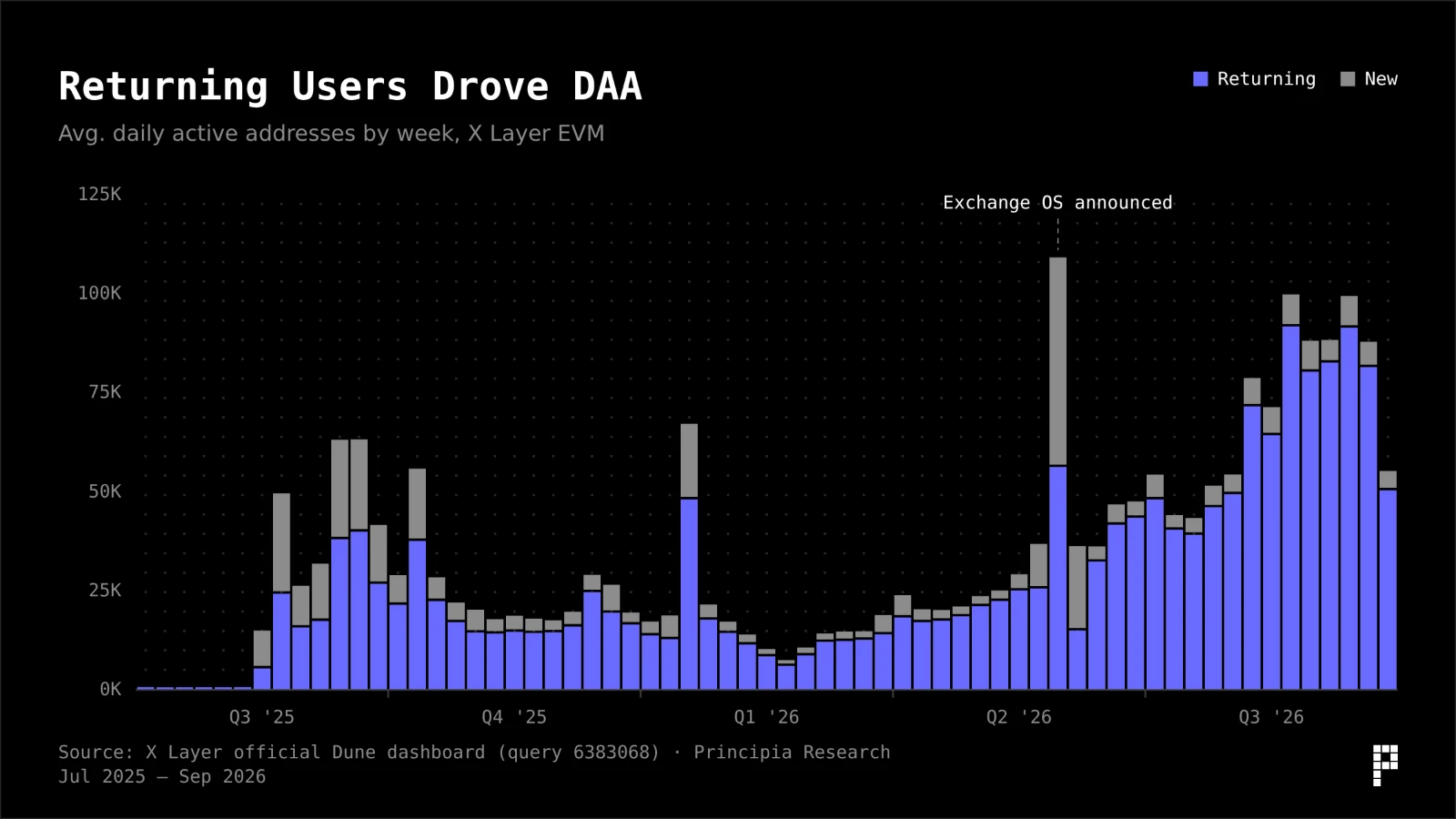
The X Layer EVM averaged 1.22M daily transactions in Q3 (+262% QoQ) and 70.5K daily active addresses (+89%).
User Quality: Returning Users Are Sticky
Q3 growth came mainly from returning users rather than new ones. Returning addresses averaged 64.3K a day, up 131% QoQ, while new addresses averaged 6.2K a day, down 34% from 9.4K in Q2. Returning addresses now make up 91% of daily actives, up from 75% in Q2.
Retention among new users is middling. We sampled one day a week in Q3 and tracked whether that day’s new addresses transacted again over the next 30 days:
- Transacted again within 30 days: a median of 42% across 13 sample days.
- Still active on days 8–30: a median of 28%.
On Jul 1 and Aug 5, two campaign-driven acquisition days, X Layer gained 16K and 11K new addresses, but only 11% and 18% of them transacted again within 30 days. Overall, X Layer’s activity rests on a core of addresses that keep coming back. The key next step is to turn more campaign-driven users into lasting ones.
TradeZone: 2.6x EVM Throughput in Q3
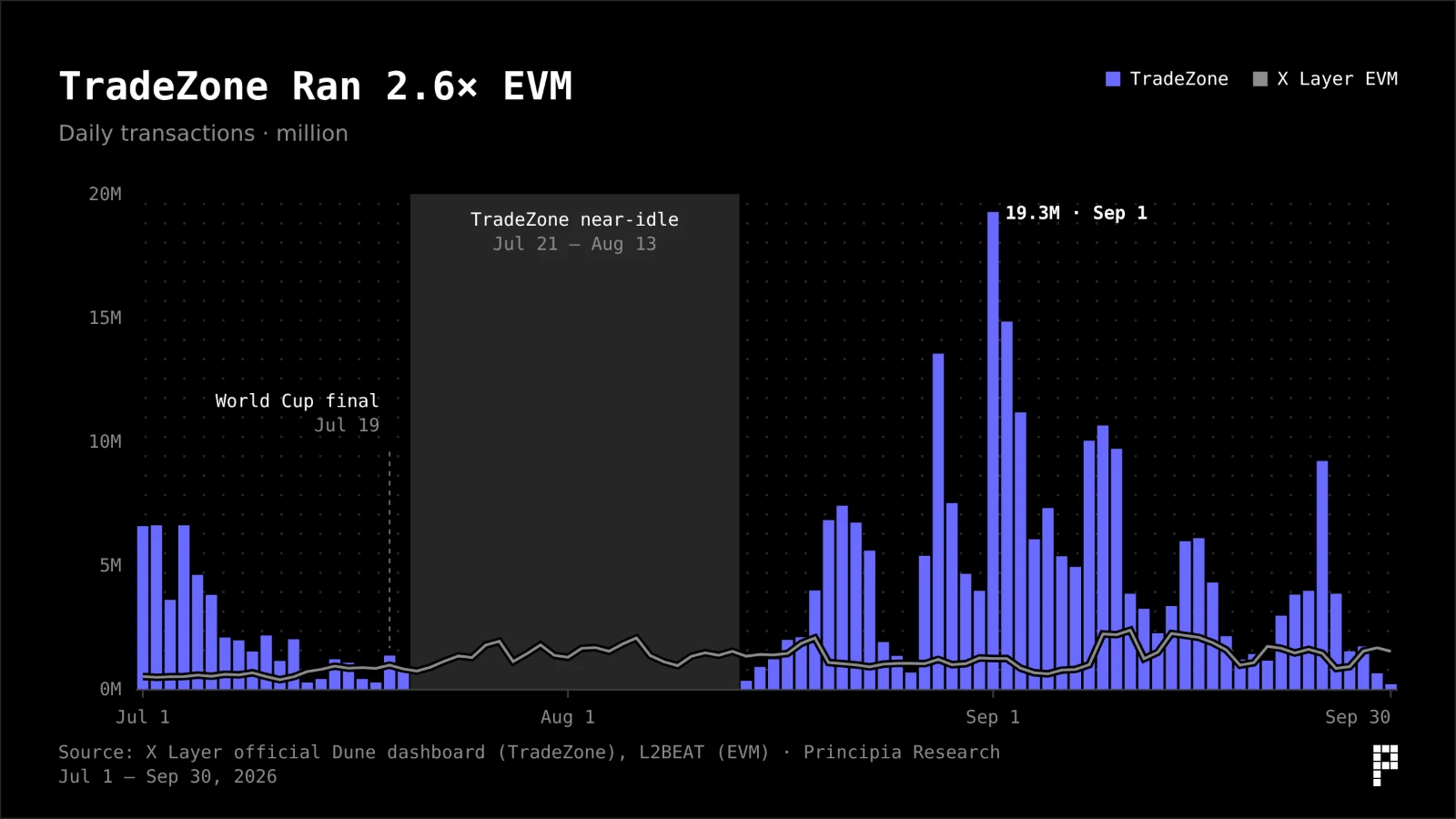
TradeZone processed 287M transactions in Q3, 2.6x the EVM’s 112M, bringing its cumulative total to 458M by Sep 30.
TradeZone’s quarter played out in three phases:
- Jul 1–20: World Cup predictions. The first Exchange OS market was the simulated “2026 World Cup Outcomes” (bets placed in XP points). From Jun 3 to Jul 19 it covered 104 matches, drew about 450,000 participants and paid out $3.94M in rewards. In early July, TradeZone averaged about 161K daily active addresses.
- Jul 21–Aug 13: the gap between seasons. With no new market after the World Cup, activity fell to about 2,200 transactions a day.
- Mid-August to Sep 30: Outcomes League Season 2. The season opened on Aug 17 with a prize pool of up to $600K. TradeZone hit a Q3 record of 19.28M transactions on Sep 1 and averaged about 76K daily active addresses in September. Activity dropped to zero again when the season ended on Sep 30.
TradeZone is extremely dense: in September each active address averaged about 70 transactions a day. That fits order-book trading, where every order placement and cancellation counts as a transaction. Notably, all Q3 TradeZone traffic came from simulated predictions settled in XP rather than real-money trading, so its transaction counts are not directly comparable with the EVM’s. Even so, it showed that the architecture can carry massive concurrent load.
Competitors
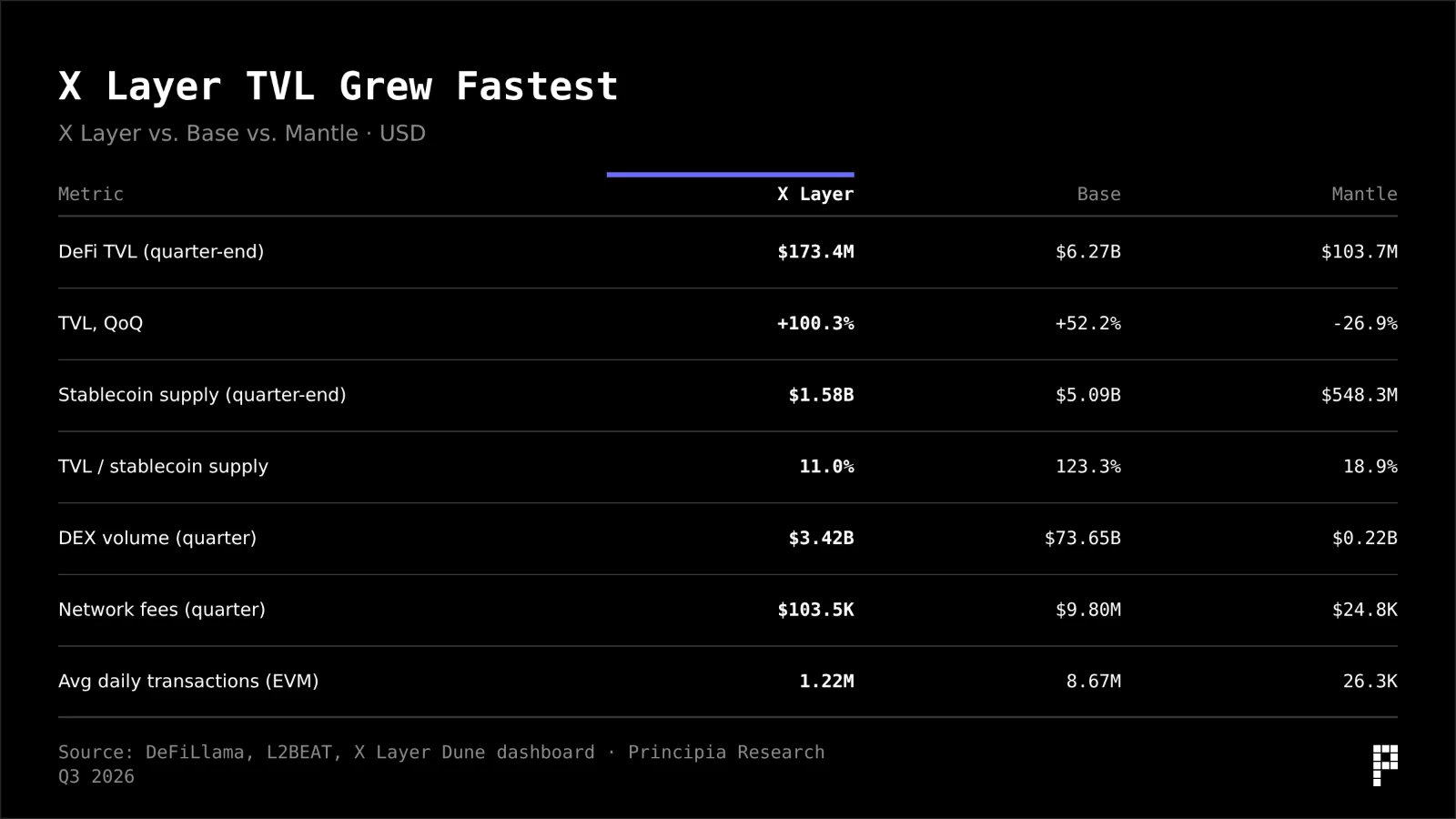
Among exchange-backed chains of similar scale, X Layer posted the fastest TVL growth in Q3. Its clearest weakness is stablecoin utilization: only 11% of its stablecoins sit in DeFi, versus over 100% on Base. Counting TradeZone, X Layer’s total Q3 transactions (399M) already equal half of Base’s (798M).
Ecosystem Overview
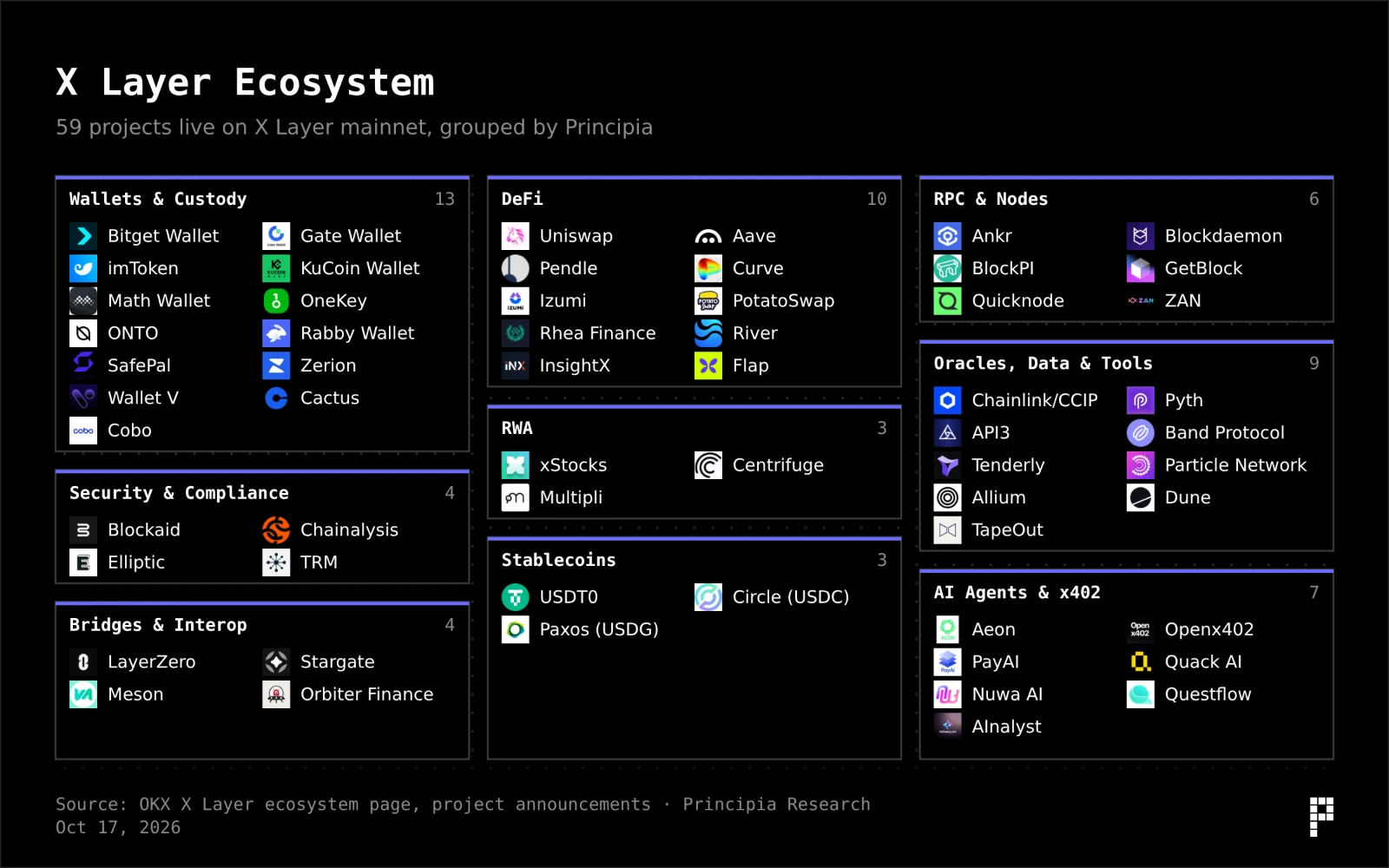
One thread runs through X Layer’s ecosystem in Q3: OKX is moving its own products—wallet, payments, tokenized stocks and stablecoin reserves—onchain one by one. This approach gets volume up fast: it first lays down fertile ground for activity, and native projects can then grow from that ground. We think this playbook is sound, and it is the same logic behind X Layer’s strong push behind TapeOut.
RWA
xStocks, Backed’s tokenized US equities, lead RWA on X Layer. They went live on Jun 15, 2026, and on Jul 16 OKX added more than 40 tokenized stocks and ETFs minted on X Layer. The market cap of xStocks on X Layer grew from $91.5M on Sep 12 to $173M on Sep 20, making it the third-largest chain for xStocks.
The onchain data can be read in two parts:
- Minted supply far exceeds circulating supply. X Layer hosts 222 xStocks contracts with about $1.72B minted in total. But $1.16B of that sits in tokens with 10 or fewer holders—inventory pre-minted by the issuer.
- Much of the circulating supply is also held by OKX. About 90% of CRCLx and MSTRx sit in OKX exchange wallets. The most widely held are GOOGLx (1,950 addresses) and SPCXx (1,849). (Snapshot as of Oct 17)
Other RWAs are still small. Centrifuge launched its Treasury token deJTRSY and AAA CLO token deJAAA in June, and Multipli’s rwaUSDi stands at about $3.7M.
RWA is one of OKX’s core focus areas. To build RWA liquidity, X Layer launched an incentive program of up to $5M in August, with a first round of $300K for Uniswap LPs in RWA token pools. Compared with incentive programs on other chains, though, this is still playing catch-up. Rather than buying short-lived traffic with incentives alone, the X Layer team would do better to use mechanism design to drive lasting trading activity.
DeFi
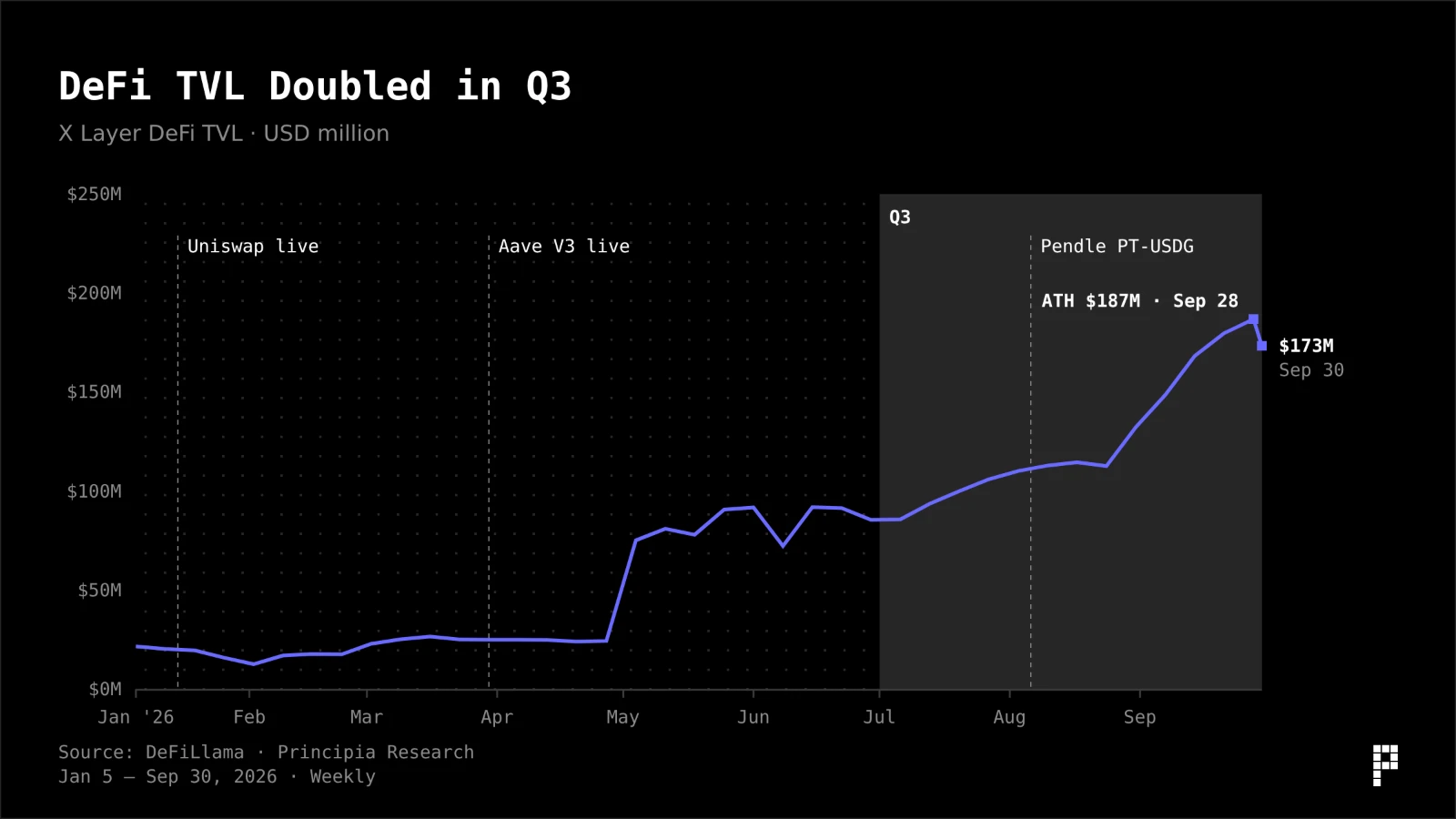
DeFi TVL doubled in Q3, from $86.5M to $173M, after setting an all-time high of $187M on Sep 28. Almost all of the growth came from one strategy: looping Pendle’s PT-USDG on Aave.
- Pendle: The PT-USDG-29OCT2026 pool launched on Aug 6. Within a month it reached $37.5M in TVL and became X Layer’s second-largest protocol, ending the quarter at $70.4M.
- Aave V3: Launched on Mar 30. After Aave listed PT-USDG as collateral (93.59% LTV), borrowing rose from $10.6M at the end of Q2 to $79.4M (7.5x), and utilization climbed from 14% to 40%.
- Incentives: X Layer committed about $500K in incentives for the first month, roughly $150K of it for PT-USDG on Aave.
DeFi’s core problem is concentration: Aave, Pendle and Uniswap V3 together hold over 90% of TVL. The loop also depends on incentives and on a PT that matures on Oct 29; in Q4, the question is whether that capital rolls into the new February 2027 PT. Even so, the picture is a big improvement on the barren DeFi landscape of the past, and the next step is to bring in more established DeFi protocols from other chains.
On the DEX side, Q3 volume reached $3.42B, or $37.2M a day (+140%). Uniswap, live since January, took 96%, split between V3 (50.7%) and V4 (44.9%).
AI
OKX positions X Layer as the payment chain for AI agents, with gas-free stablecoin payments as the core selling point. Key milestones over the past year:
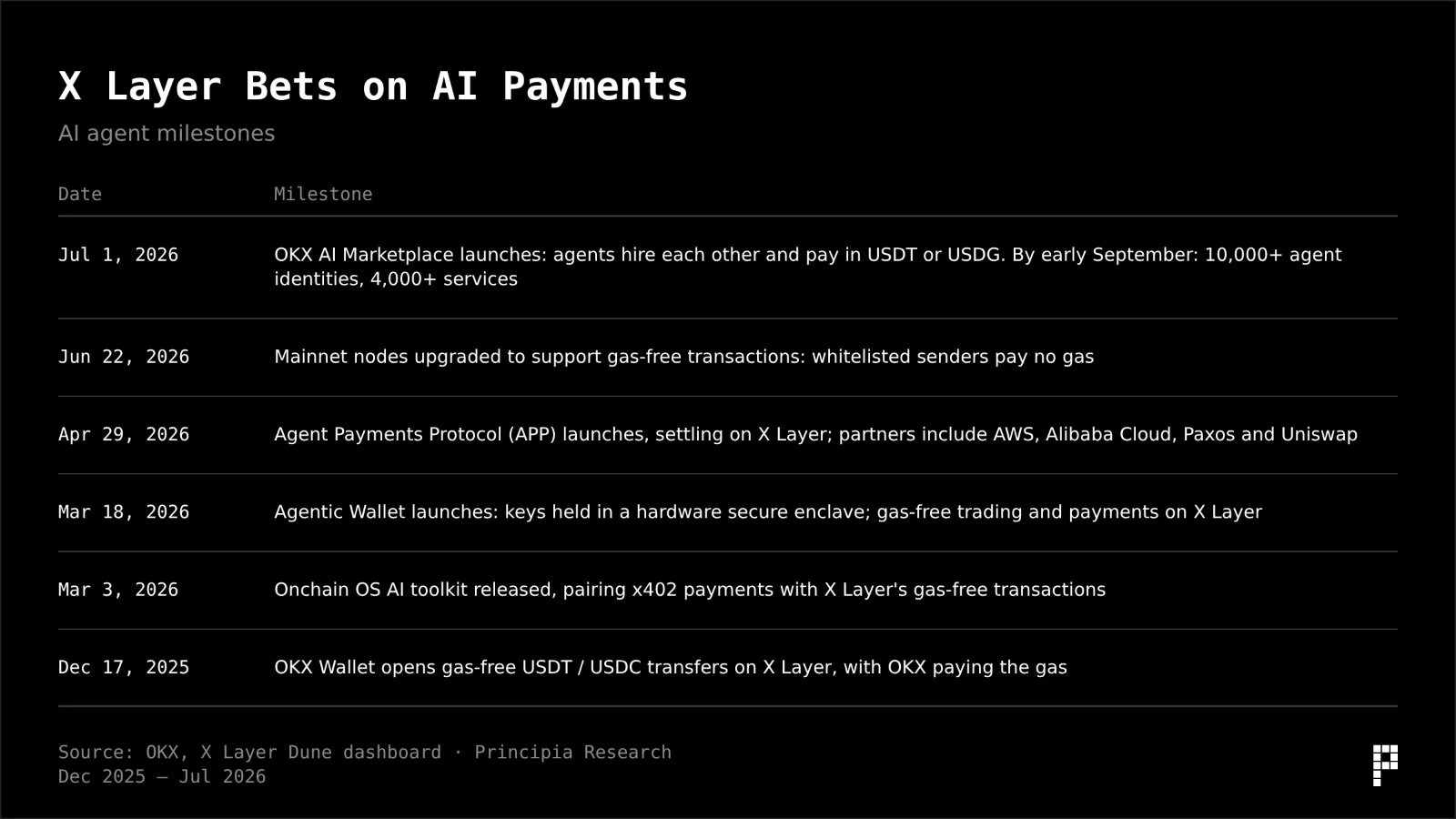
The impact is already visible onchain. Official daily active addresses separately count the real signers behind gas-free stablecoin transfers: on Sep 11, for example, they numbered about 44K, or 40% of that day’s 105K actives.
Stablecoins
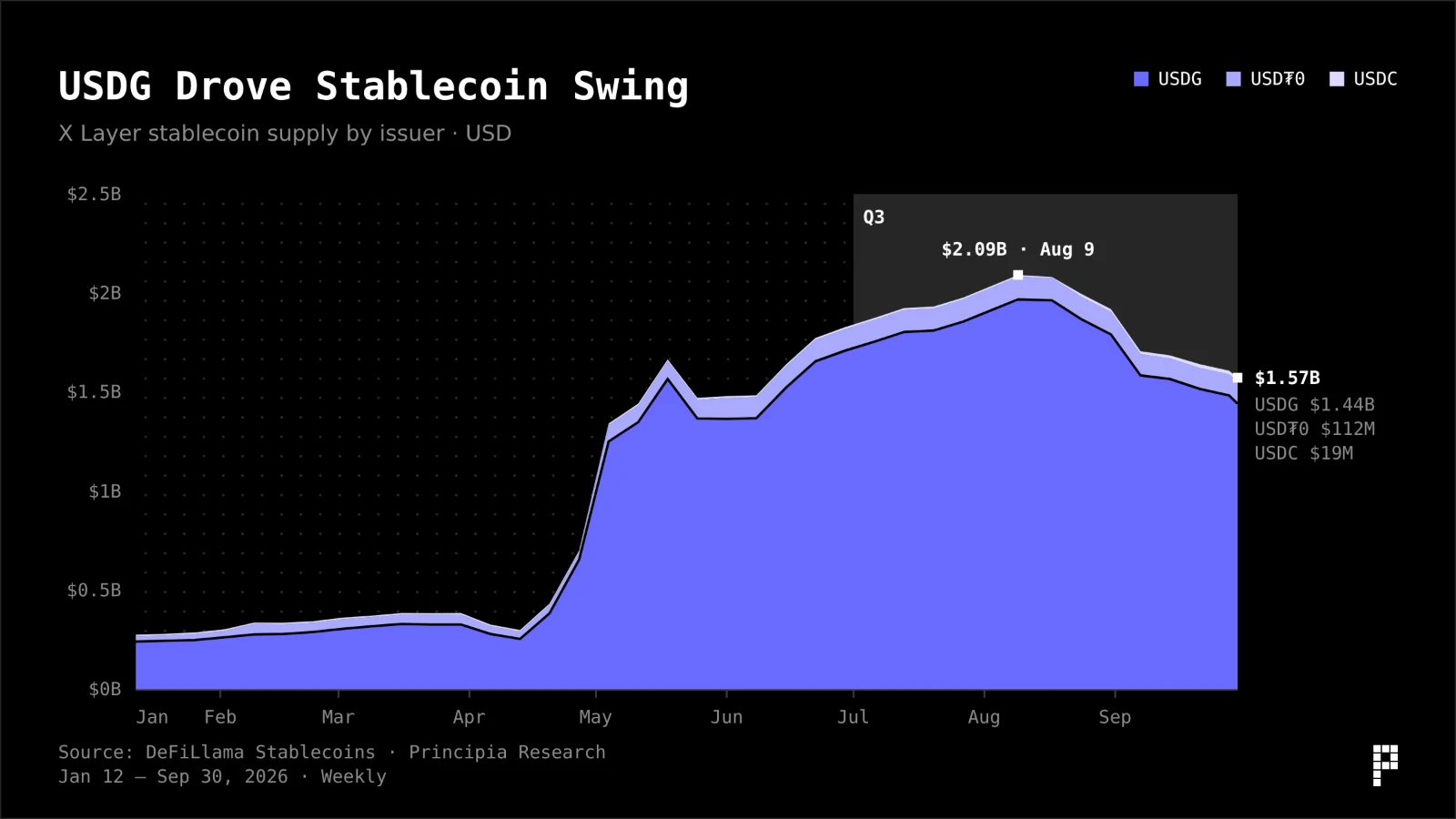
X Layer’s stablecoin supply spiked and then pulled back in Q3. It peaked at $2.09B on Aug 9 and ended the quarter at $1.58B, down 14.2% QoQ. Nearly all of the move came from USDG, which fell from $1.97B to $1.44B, while USD₮0 and USDC both grew, with USDC doubling from $9.7M to $18.8M. USDG still held 91.4% at quarter-end.
The issuer lineup is now complete. X Layer carries all three major dollar stablecoins: USD₮0 (integrated in September 2025), USDG (live since Sep 26, 2025) and native USDC. On Aug 6, Circle announced native USDC and its cross-chain protocol CCTP on X Layer (the contract was deployed on Jul 27). X Layer is also USDG’s largest chain, holding about $1.51B in late September—nearly half of USDG’s $3.2B supply.
The large USDG swings reflect OKX moving its own exchange reserves, not onchain user demand. Based on DeFiLlama’s public list of OKX wallets, 83% of onchain USDG sits in OKX exchange addresses:
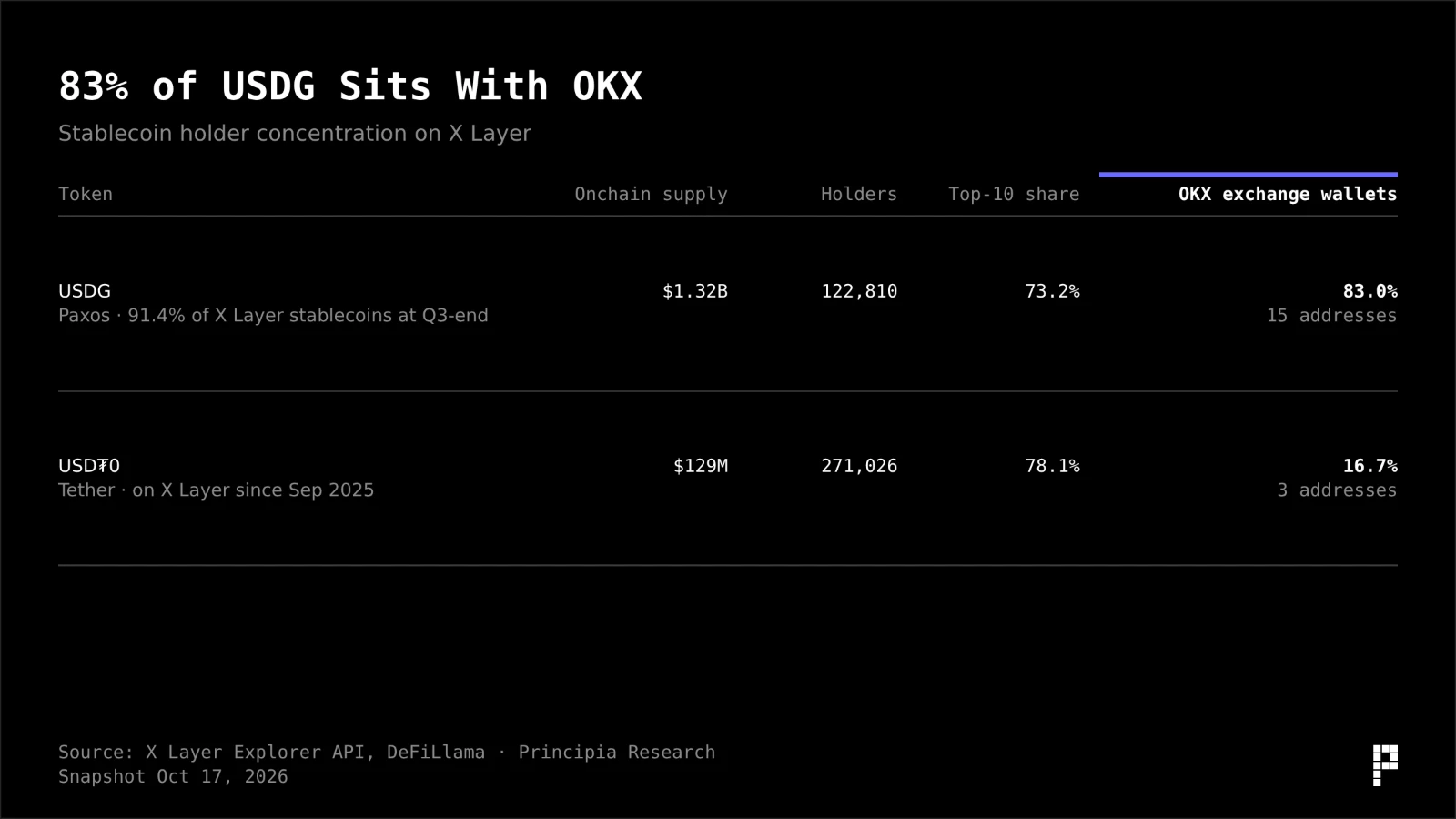
This also explains why X Layer has plenty of stablecoins but little TVL: at the end of Q3 only 11% of stablecoins were deployed in DeFi. That share is rising fast, though, from 4.7% at the end of Q2. For X Layer, the shortest path to growth is putting the USDG parked in OKX’s exchange to work onchain and bringing its DeFi ecosystem to life.
Developer Ecosystem
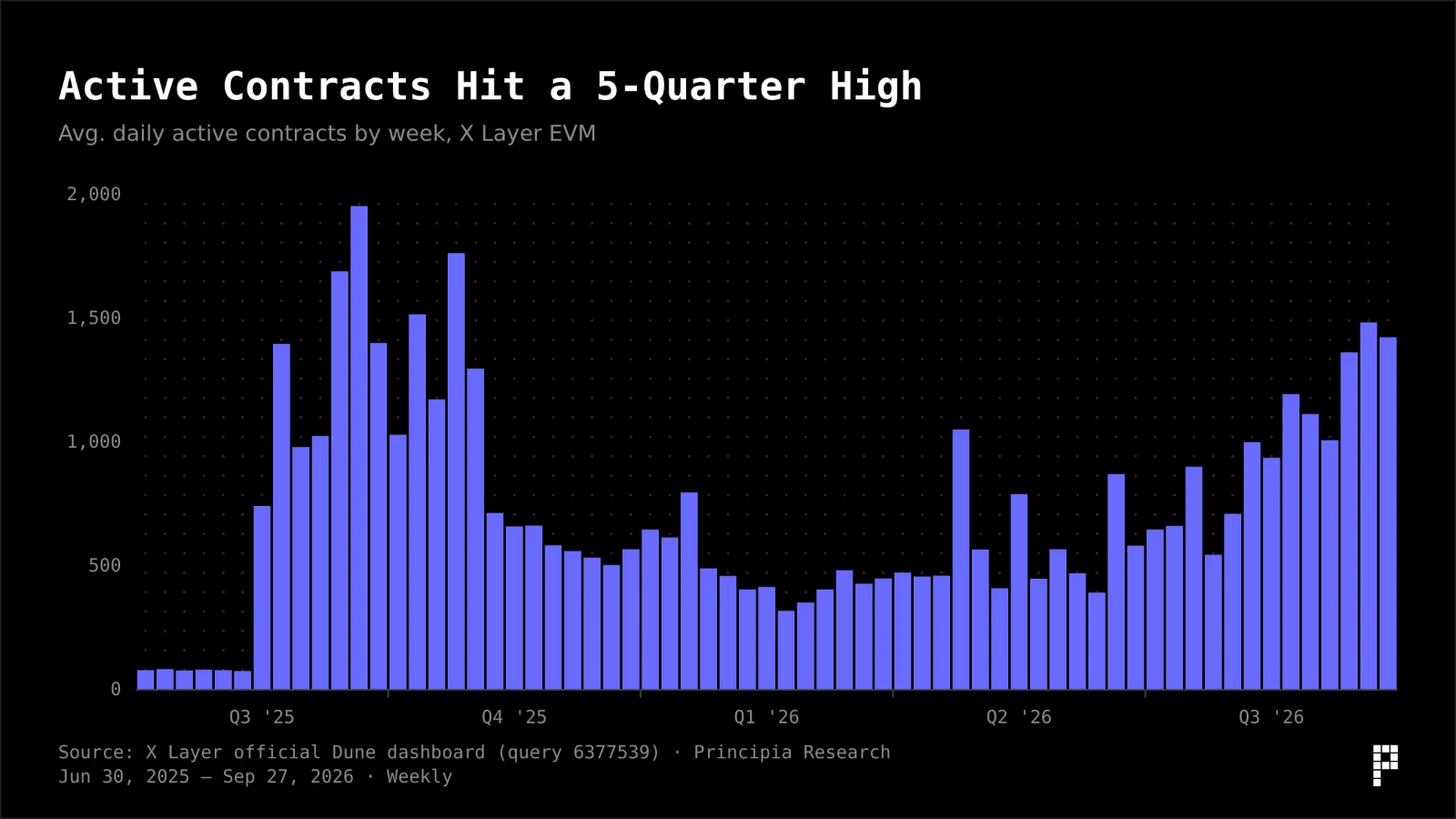
The developer ecosystem is recovering, though it still leans mainly on hackathons and competitions run by OKX. Daily active contracts averaged 1,036 in Q3, up 79% QoQ and the highest in five quarters.
- Funding: The $100M X Layer Ecosystem Fund, set up in August 2025, began paying out through hackathons in January 2026.
- Q3 programs: The Build X series ran OKX AI Genesis (Jul 2–27) and AI Season (Aug 7–21). OKX Dev Day in September offered up to $100K in prizes, focused on RWA, tokenized stocks and AI agents.
- Tooling: With the execution layer now on Reth, developers get 200-millisecond preconfirmations through Flashblocks. Gas-free transactions and x402 let payment apps ignore whether users hold any OKB.
Compared with competitors such as BNB Chain, X Layer’s prize money per hackathon holds up well; the gap lies in how often it runs them and in what happens after they end. BNB Chain already has a transparent incubation pipeline that covers funding and VC introductions, ecosystem partnerships and exit paths. X Layer still works with projects one at a time. Its next step is to build a global developer community and a complete incubation process.
Institutional Adoption
Institutional progress is happening mainly at the OKX corporate level, then flowing through to X Layer.
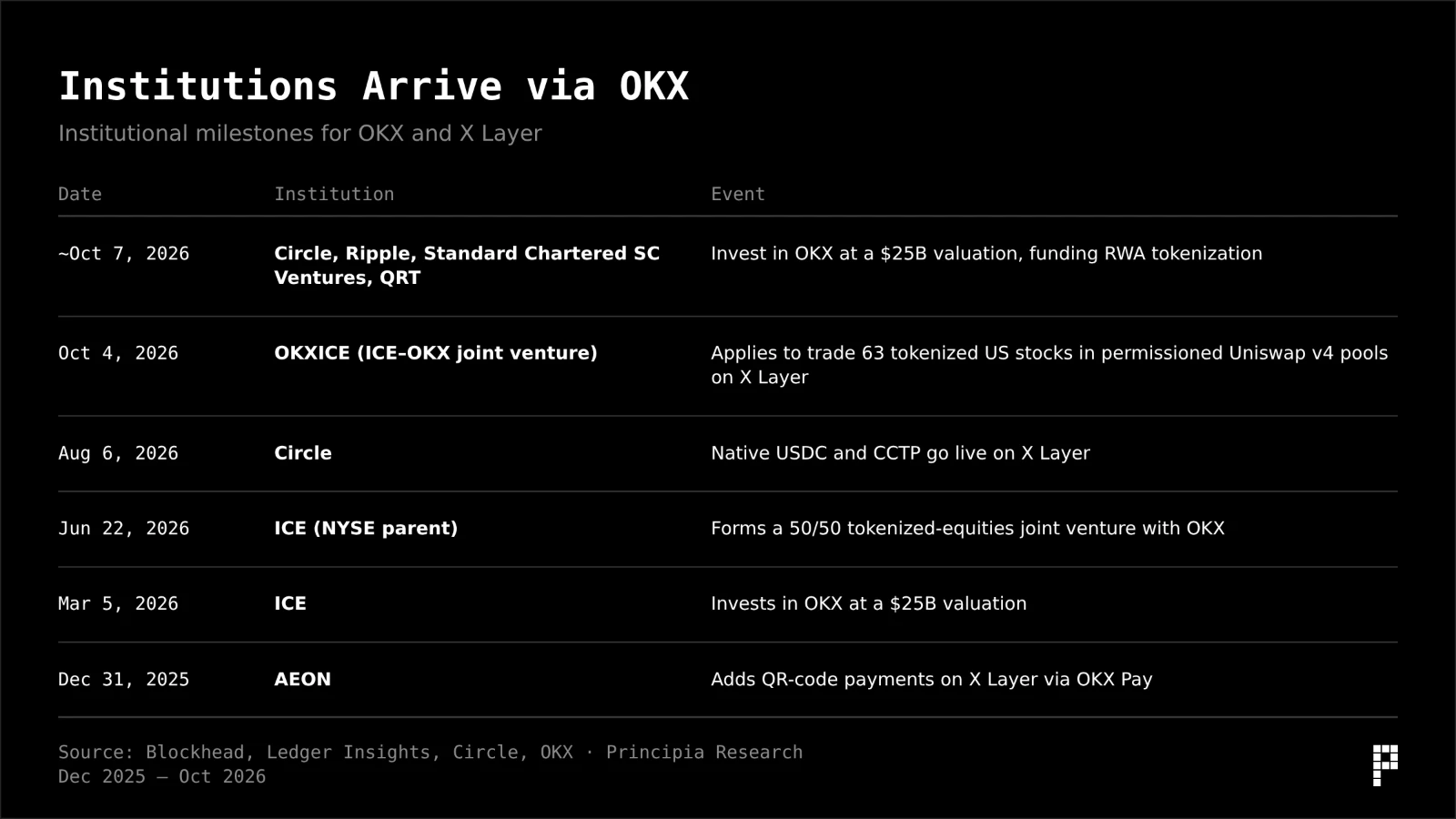
The most important institutional development came just after quarter-end, from ICE, the parent company of the New York Stock Exchange. In early October, OKXICE, its 50-50 joint venture with OKX, notified the SEC that it plans to run a tokenized securities venue under an exemption the SEC issued on Sep 17. More than 60 US stocks, including Apple, Nvidia, Tesla and JPMorgan, will trade against USDC, USDG and USDT in permissioned Uniswap V4 pools on X Layer, with trading set to begin as soon as early November. For X Layer, this marks the start of regulated onchain trading in US equities.
Protocol Upgrades
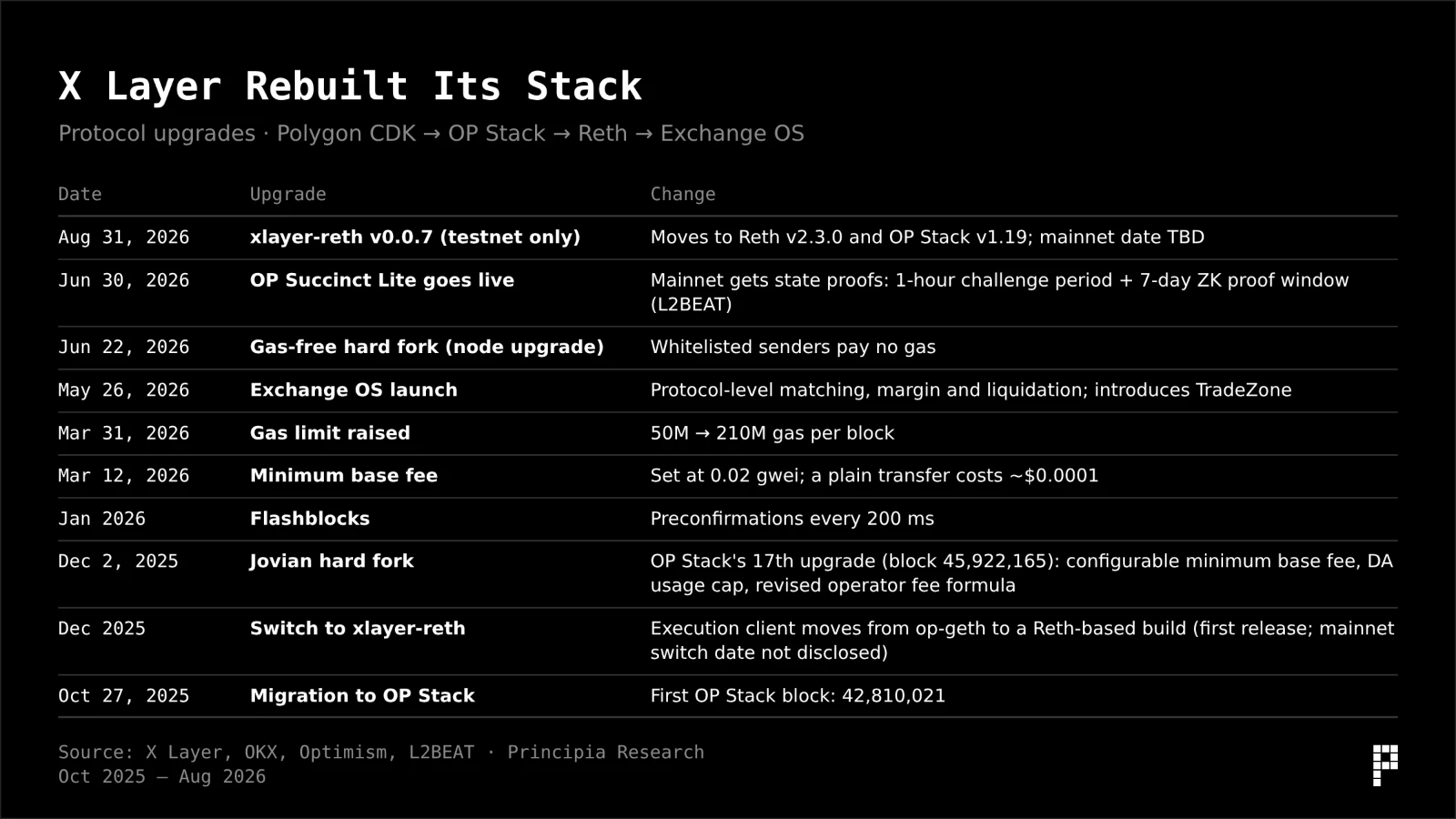
Over the past year, X Layer has rebuilt almost its entire stack: it moved from Polygon CDK to the OP Stack, switched its execution client from Geth to Reth, and added Exchange OS on top.
Reth
X Layer’s execution client is now xlayer-reth. The most direct gain from Reth is Flashblocks: since January 2026, the sequencer has issued a preconfirmation every 200 milliseconds, while blocks still land once a second. Combined with the gas limit raised to 210M in March, the chain can in theory process around 10,000 simple transfers per second.
Jovian
Jovian is the OP Stack’s 17th network upgrade. It activated on X Layer at block 45,922,165 on Dec 2, 2025. Its main changes:
- A configurable minimum base fee. In March 2026, X Layer set it at 0.02 gwei and tuned its EIP-1559 parameters so the base fee barely moves. Fees now sit at a stable floor, with an ERC-20 transfer costing about $0.0001.
- A cap on data availability (DA) usage. The compressed data a block posts to Ethereum must stay within a limit, which stops spam from driving up L1 costs.
- A revised operator fee formula.
For X Layer, Jovian matters because it turns ultra-low, stable fees into a configurable parameter—a prerequisite for a payments chain.
Exchange OS
Exchange OS is a protocol upgrade announced on May 26, 2026, and the most important change of the quarter. It turns OKX’s core capabilities—matching, margin, liquidation, settlement and risk management—into public services at the protocol layer, so anyone can launch spot, perpetual and prediction markets on top.
With Exchange OS, X Layer now runs a two-layer architecture: the EVM holds assets, and TradeZone handles trade execution.
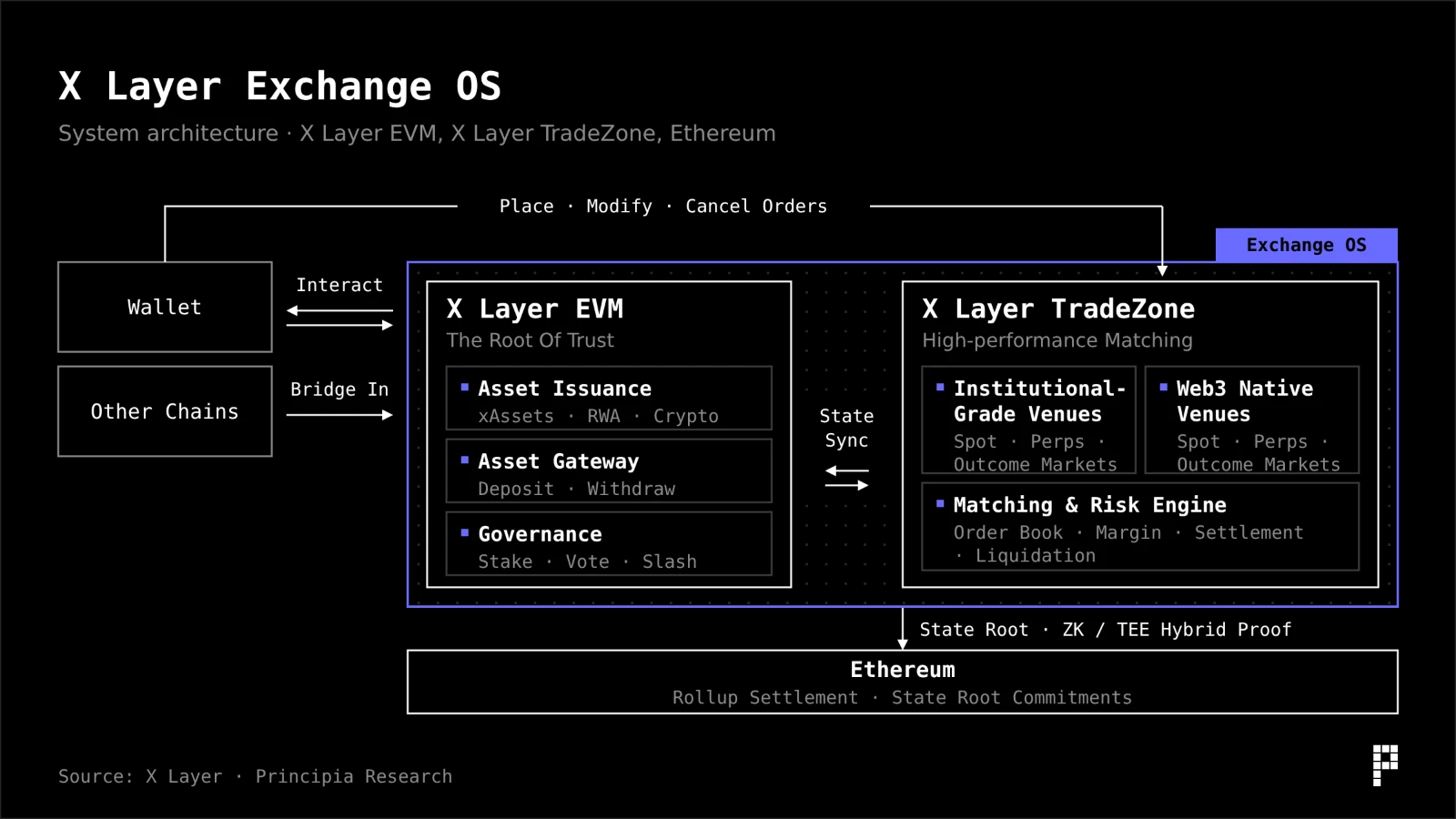
- X Layer EVM: OKX’s Ethereum L2. It migrated from Polygon CDK to the OP Stack on Oct 27, 2025. It posts data to Ethereum blobs and, since Jun 30, uses OP Succinct Lite for state proofs.
According to the whitepaper:
- The X Layer EVM is the settlement layer. User assets live on the EVM, as does the OKB staked by market operators, and slashing is executed there too.
- TradeZone handles execution. It runs four engines—matching, margin, liquidation (including auto-deleveraging) and settlement—and claims millisecond latency, up to 300,000 TPS and gas-free trading for users. Its state syncs with the EVM, and if the TradeZone sequencer goes offline, users can withdraw their assets straight back to the EVM.
- Launching a market requires staking OKB. A single stake covers spot, perpetual and prediction markets; listings beyond the free quota go to auction.
Token Value Accrual and Valuation
OKB’s value comes not from X Layer gas but from its position in the OKX ecosystem. Q3 onchain fees totaled just 1,003 OKB, less than 0.02% of supply on an annualized basis.
Mechanism
- Fixed supply of 21M. On Aug 18, 2025, OKX upgraded the contract to remove minting and burning. Supply has not grown since, and the quarterly manual burns have stopped; OKX has not said publicly whether buybacks continue.
- The only gas token on X Layer. But the minimum base fee is just 0.02 gwei, and most wallet and TradeZone transactions are gas-free, so gas creates little demand for OKB.
- Exchange OS staking (new utility). Anyone launching a market on Exchange OS must stake OKB, and misconduct can be slashed. This is OKB’s only new utility in 2026 and its most important source of value accrual. Staking thresholds, lockups and slashing ratios have not been published, and no third-party market has launched yet.
Taken together, this design sets X Layer fundamentally apart from exchange-backed chains such as Mantle and BNB Chain. Those are general-purpose chains where the exchange mainly supplies capital and users. X Layer has moved the exchange itself—matching, margin, liquidation and settlement—onchain, making it a full-stack onchain trading system: the EVM holds assets, TradeZone executes, and OKB governs access and accountability. Structurally, it looks more like Hyperliquid (HyperCore matching plus HyperEVM) than Mantle or BNB Chain. OKB’s value anchor is moving from onchain fees to the size of the entire onchain trading market.
Roadmap and Outlook
Q3 proved that X Layer can carry heavy traffic; Q4 has to prove that traffic can turn into real trading and real capital. The official roadmap splits 2026 into three steps: launch Exchange OS in Q2, open it to outside deployers in Q3 (now delayed), and upgrade and optimize the protocol in Q4. No plan for 2027 has been published.
Five things to watch in Q4:
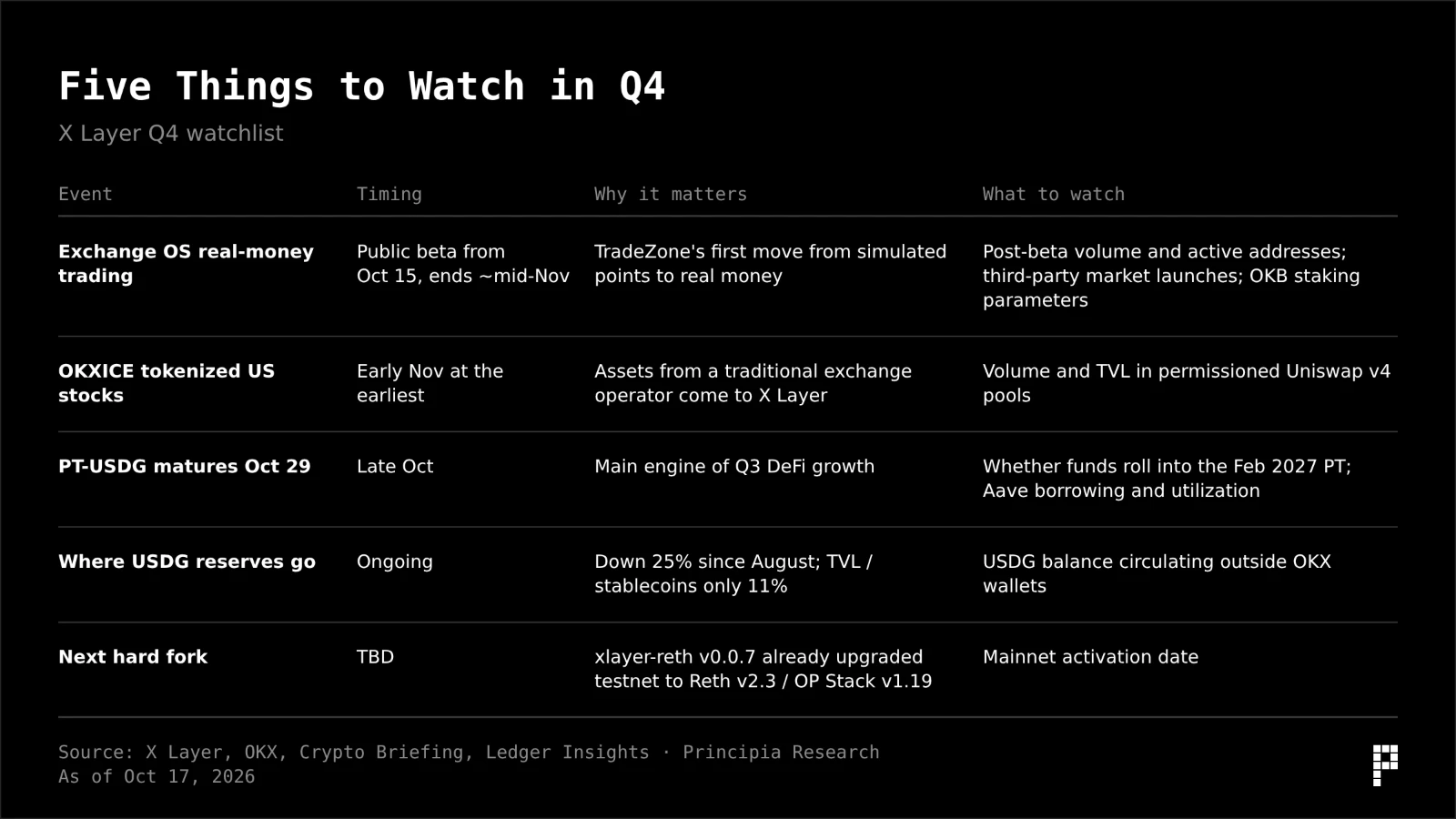
Q3 was the quarter X Layer began turning from “an exchange’s chain” into “an exchange onchain.” TradeZone ran 287M transactions through simulated predictions, EVM activity and DeFi TVL both doubled, and RWA and AI payments now have live products.
The data also shows three structural issues: most stablecoins sit with OKX itself, DeFi relies on an incentivized loop, and TradeZone traffic still comes from simulated predictions. Whether X Layer moves past them in Q4 depends on whether Exchange OS can attract real third-party markets and real-money trading. That will take innovation in product and mechanism design, backed by effective economic incentives.
Sources
Data
- X Layer official Dune dashboard (active addresses, new addresses, active contracts, TradeZone)
- DeFiLlama – X Layer (TVL, DEX volume, fees, protocol TVL)
- DeFiLlama Stablecoins – X Layer
- L2BEAT – X Layer (transactions, proof system)
- CoinMarketCap, CoinGecko (OKB price and market cap)
- X Layer Explorer API and public RPC (holder snapshots, block parameters)
- DefiLlama OKX reserves adapter (OKX wallet labels)
Official and media
- OKX Exchange OS whitepaper, The Block – Exchange OS
- OKX – Outcomes World Cup wrap, Outcomes League Season 2
- Crypto Briefing – Exchange OS spot and perps beta
- OKX – From Geth to Reth, OKX – Jovian upgrade, Optimism – X Layer migrates to the OP Stack
- Circle – Native USDC on X Layer, Global Dollar – USDG live on X Layer
- Aave governance – PT-USDG on X Layer, Crypto Briefing – Pendle
- Crypto Briefing – xStocks, Ledger Insights – OKXICE
- The Block – OKB burn, Blockhead – OKX raises at a $25B valuation
Data as of Sep 30, 2026; figures marked “snapshot” are as of Oct 17. This report is for research purposes only and does not constitute investment advice.